

Kitchen Cabinet Quality Control
Last reviewed: September 2026
The biggest risk in buying kitchen cabinets from China was never the price — it is the fear of opening a container and finding cabinets that are not quite what you approved. Different board. Off-spec dimensions. Edge banding already lifting. That fear is rational, and it has an engineering answer: quality is not inspected at the end, it is locked in at four checkpoints along the way. This article shows you exactly where those checkpoints are, what gets verified at each one, and how you can see the evidence with your own eyes before anything leaves the factory.
Quick answer — how quality gets locked in:
- Four factory checkpoints: incoming materials, cutting and edge banding, trial assembly, and pre-shipment inspection — each with written pass/fail criteria, each producing evidence you can review.
- Three ways you verify: visit the factory yourself, join a live video inspection, or appoint a third-party inspector. Any serious supplier supports all three.
- One accountable party: when the same team handles your quotation, production, inspection, and shipping, a quality problem has exactly one owner — and one phone number to call.
You can see the product ranges these controls apply to in our custom kitchen cabinets catalog — every series there goes through the same four checkpoints below.
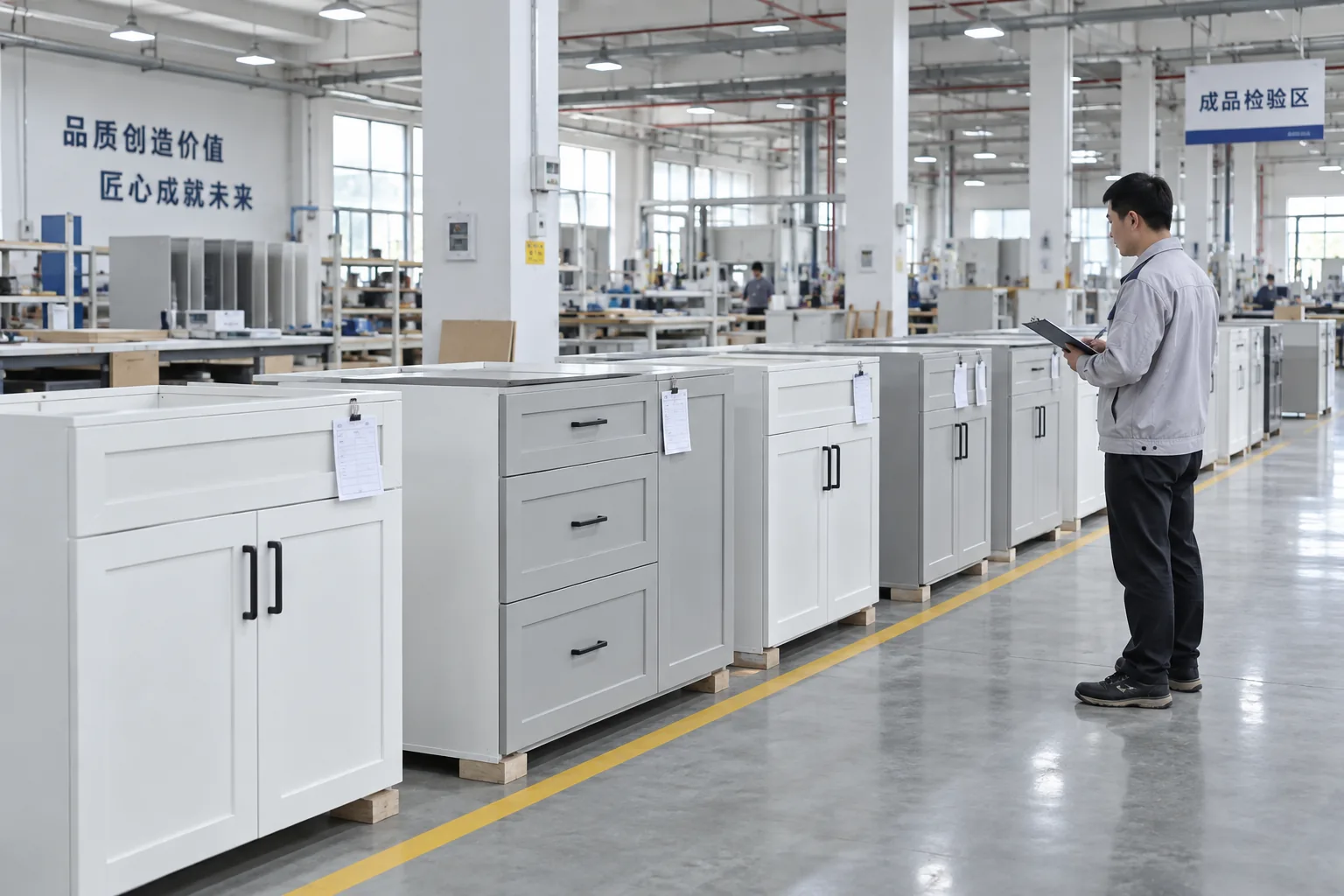
Where Cabinet Quality Goes Wrong
Most “bad container” stories trace back to one of four failure patterns. Knowing them matters, because each one is intercepted at a specific checkpoint — and a factory that cannot name its checkpoints cannot credibly promise you anything.
Material Substitution
The single most common complaint in imported cabinetry: the contract says plywood, the container holds particle board — or the board grade quietly drops between sample and production run. Emissions compliance can shrink the same way. What you see on arrival: swollen panels after the first humid season, doors that sag, a cabinet that smells different from the sample. Where it gets caught: incoming material inspection, before a single panel is cut.
Dimensional Drift
Cabinets are an assembly game: a one-millimeter error per panel becomes a door gap you can slide a coin through. Drift creeps in through dull saw blades, uncalibrated CNC settings, or rushed setups between orders — and it multiplies on non-standard sizes, where every dimension is unique to your project. (We build fully to-order dimensions routinely — see what custom sizes and non-standard orders actually cover.) What you see on site: installers shaving panels, uneven door reveals, countertops that do not sit level. Where it gets caught: first-piece inspection at cutting, and again at trial assembly.
Finish and Edge Defects
Edge banding applied with the wrong adhesive or temperature peels within months. Lacquer sprayed in a dusty booth shows orange peel, runs, or color variation between batches. Veneer laid without grain matching looks like patchwork across a run of doors. What you see: lifted edges, cloudy gloss, doors that visibly differ from each other in the same kitchen. Where it gets caught: the edge banding and finishing checkpoint, panel by panel.
Hardware Downgrade
Hinges and slides are invisible at delivery and decisive at year two. A quoted premium brand swapped for a lookalike domestic tier works fine on day one — then doors start dropping and drawers start grinding. What you see: soft-close that stops closing softly, sagging doors, slides that derail under load. Where it gets caught: hardware verification at trial assembly, checked against the brand and model written into your order.
The Four Checkpoints Where Quality Is Locked In
Each checkpoint below follows the same discipline: a defined inspection scope, written pass criteria, and a record that reaches you. This is what “quality control” means when it is a system rather than a slogan.
| Checkpoint | What gets checked | Pass criteria | What you get |
|---|---|---|---|
| 1. Incoming materials | Board brand, type and thickness; emissions grade; decor paper and edge banding batch match | Matches the material schedule in your order documents | Your carcasses are the contracted material — nothing substituted |
| 2. Cutting & edge banding | First-piece dimensions; saw-cut quality; banding glue line, thickness and corner radius; panel-by-panel visual | Within tolerances agreed in the shop drawings; no lifted or gapped banding | Every panel matches the approved sample |
| 3. Trial assembly | Key units fully assembled: door gaps, drawer glide, cabinet squareness, hardware brand and drilling positions | Even reveals, smooth travel, square carcasses, hardware as specified | Your installers assemble, not repair |
| 4. Pre-shipment inspection | Random-sample drawing check across the order; final finish inspection; photo and video documentation | Samples conform to confirmed drawings and samples | You see this exact shipment before it is packed |
Checkpoint 1: Incoming Material Inspection
Before production, board deliveries are verified against your order’s material schedule: manufacturer, panel type, thickness, and emissions grade. For the US market, panels are specified to CARB Phase 2 / EPA TSCA Title VI compliance; other destinations carry their equivalent grades, stated in writing in the order documents. Decor paper and edge banding are checked against the approved finish samples so batch variation never enters the line. What this buys you is simple: the material in your cabinets is the material in your contract.
Checkpoint 2: Cutting and Edge Banding
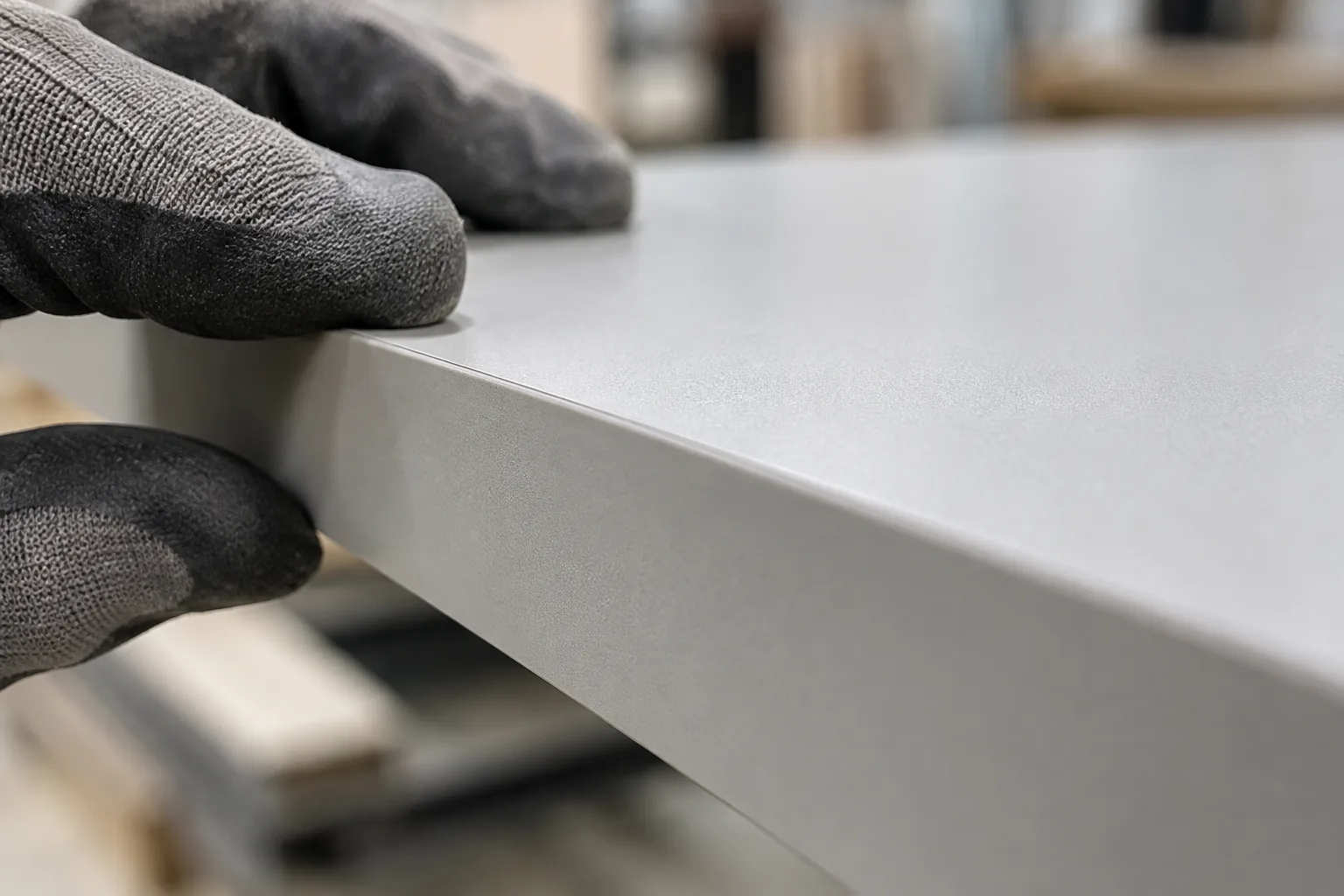
Cutting starts with a first-piece check — the first panel off the saw is measured against the shop drawing before the run proceeds, and measurements repeat at intervals through the batch. Edge banding is inspected panel by panel: glue line consistency, banding thickness, corner radius, and adhesion. Panels that fail do not get reworked into the order; they leave the line. What this buys you: every panel in your container matches the sample you approved — same dimensions, same edges, same surface.
Checkpoint 3: Trial Assembly
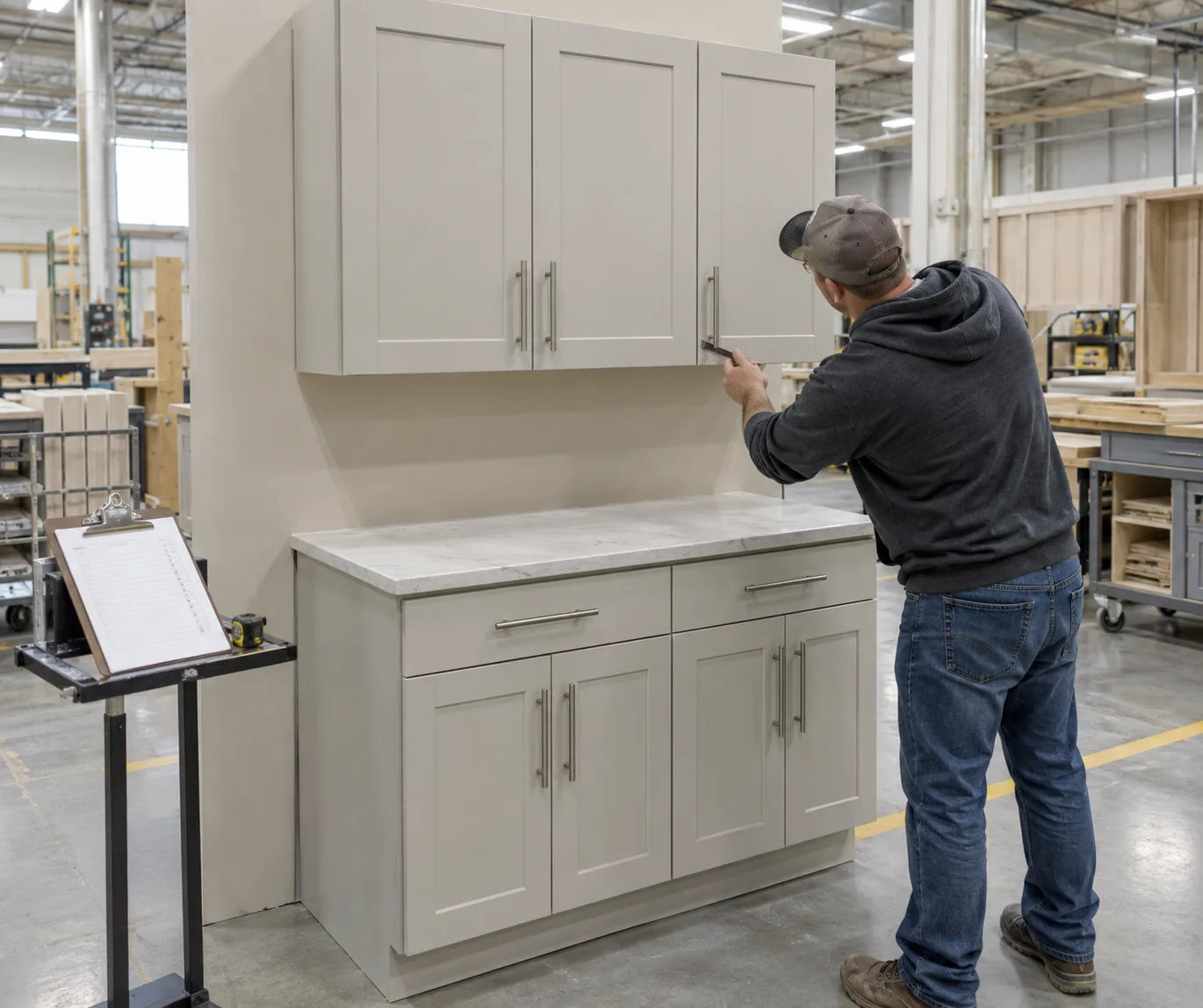
Key units from your order — typically a base cabinet, a wall cabinet, and the most complex unit in the set — are fully assembled on the factory floor before packing. Inspectors check door reveals for evenness, drawers for smooth full-extension travel, carcasses for squareness, and hardware against the brand and model in your specification, including drilling positions for on-site fitting. What this buys you: your installation crew spends its days assembling cabinets, not correcting them. Trial assembly is where “fits on paper” becomes “fits in your kitchen.”
Checkpoint 4: Pre-Shipment Inspection
After production and before packing, a random sample is drawn across the order — units from different production days and different product types — and checked against the confirmed drawings. Finish surfaces get a final visual pass under inspection lighting. The whole inspection is documented: photos and video of your actual units, not library images, sent to you for confirmation before a single carton is sealed. What this buys you: you approve this specific shipment with your own eyes, while corrections are still cheap.
Not every defect is equal, and a written grading standard keeps inspections honest. This is the framework professional inspections use — and the one your contract should reference:
| Defect type | Severity | Typical examples | Action |
|---|---|---|---|
| Material or spec deviation | Critical | Wrong board type, wrong hardware brand, non-compliant emissions grade | Reject — unit does not ship |
| Function or fit failure | Major | Out-of-tolerance dimensions, binding drawers, misaligned doors, drilled holes off position | Rework before packing |
| Surface and finish flaws | Major / Minor by visibility | Lifted banding, lacquer runs, color mismatch on visible faces | Rework; minor flaws on hidden faces assessed case by case |
| Cosmetic marks on hidden surfaces | Minor | Light scuffs on carcass interiors or back panels | Documented; accepted only with buyer sign-off |
One honest caveat: checkpoints only exist if the factory runs them when nobody is watching. That is why inspection discipline belongs in your supplier evaluation from day one — our guide on how to evaluate a cabinet factory before you place the order covers the twelve checks that tell a systematic manufacturer from a lucky one. This article picks up where that one ends: once the order is placed, here is how quality actually gets delivered.
Three Ways You Can Verify Before Shipment
A supplier’s checkpoints protect you even when you never see them — but you do not have to take them on faith. There are three established ways to witness quality yourself, and a confident supplier supports all three. The choice is yours, and it changes nothing on our side except where we point the camera.
| Verification method | Cost direction | Time required | Evidence strength | Best for |
|---|---|---|---|---|
| Visit the factory yourself | Travel cost on your side | 1–2 days on site | Strongest — full access, your own eyes | First orders, large projects, whole-house packages |
| Live video inspection | None beyond your time | 1–2 hours per session | Strong — real-time, interactive, recordable | Repeat orders, mid-production checks, pre-shipment review |
| Third-party inspection | Inspection fee, scaled to order size | Half a day on site, report within days | Independent — formal report from a neutral party | Buyers without China presence, compliance-driven projects |
Visit the Factory Yourself
Nothing replaces standing on the production floor. A factory visit lets you walk the material warehouse (are panels stored flat and dry?), watch the edge banding line run, and open drawers in the trial assembly area. In Foshan, a visit typically combines the factory with a showroom, so you review finishes on full-size displays in the same trip. For first orders and project-scale purchases, this is the verification method we recommend — and the one that tends to turn a transaction into a supply relationship. If you are already comparing suppliers at the fair, you can combine it with a Canton Fair trip and schedule the Foshan visit immediately after Phase 2.
Live Video Inspection
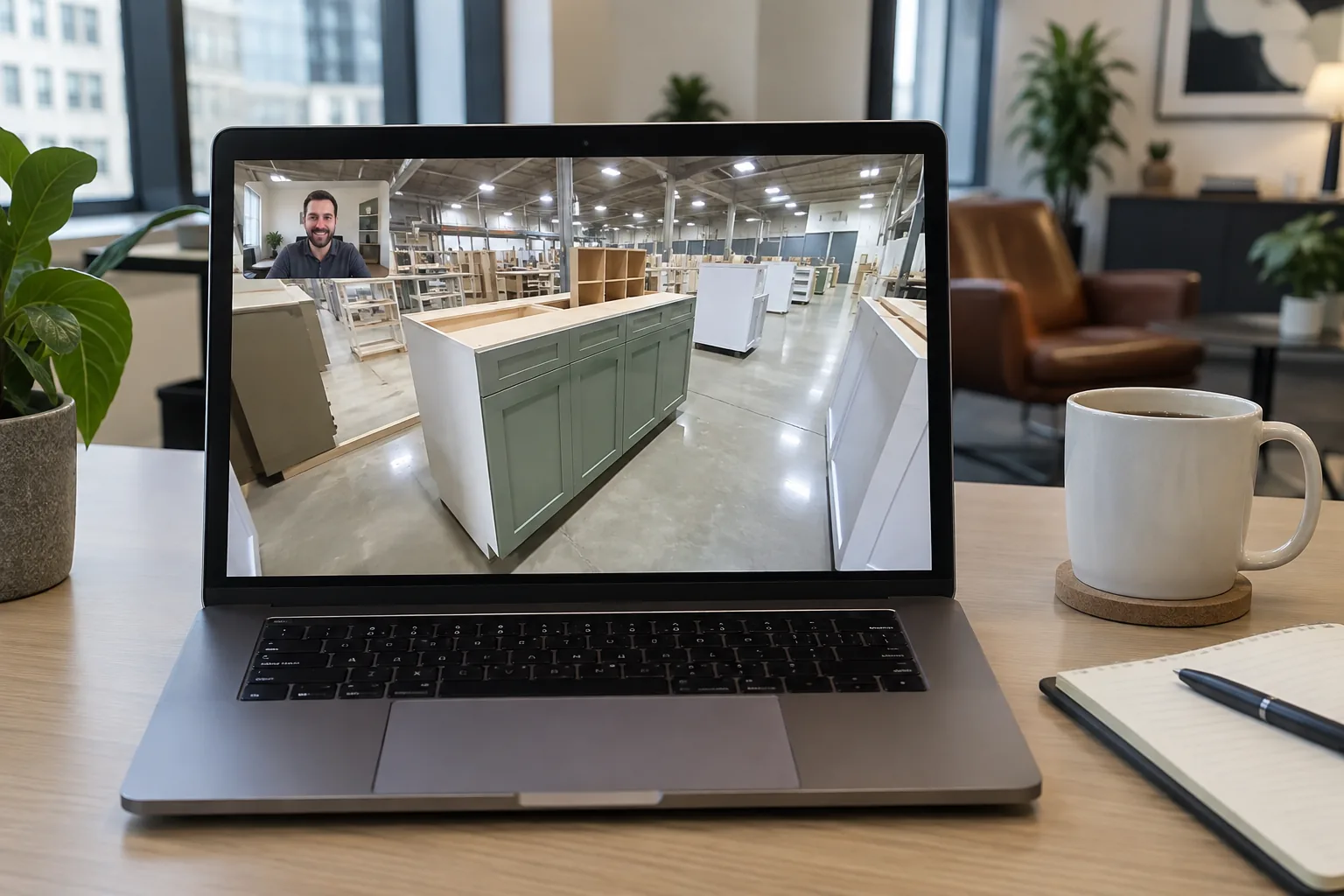
Video inspection became standard practice when travel stopped, and it stayed because it works. A typical session: you book a time, the camera walks the line in real time, you call out carton numbers for random opening, and the session is recorded for your files. You can watch your own units in trial assembly, zoom into edge banding, and check labels against your packing list — from your office, in your time zone. For repeat orders and pre-shipment reviews, this is the routine choice.
Third-Party Inspection
For buyers who want an independent pair of eyes, established inspection firms — names like SGS, Bureau Veritas, or TÜV — run pre-shipment inspections across the Foshan manufacturing belt. They sample against agreed criteria (often an AQL sampling standard), test function, and issue a formal report with photographic evidence. The fee is a modest, order-scaled line item that buyers typically arrange and pay directly, keeping the inspector’s loyalty undivided. Your supplier’s job is to make access frictionless: cartons staged, units available for assembly, records ready.
Whichever method you choose, run this checklist before the container is sealed — it is the same list we walk through with buyers:
- Carton count matches the packing list, item by item
- Labels show your project, room, and unit references — not generic marks
- Random cartons you selected were opened and re-sealed in front of you (or on camera)
- Sampled units match the confirmed drawings: dimensions, finish, hardware brand
- One complex unit was assembled and operated — doors, drawers, lift systems
- Photos or video of the inspection are in your hands, filed with the order
- Any defect found has a written resolution — rework, replacement, or documented acceptance — before packing resumes
Everything up to this point happens before the goods leave the factory. What happens next — export packing, container loading, moisture protection, and the sea journey — is its own discipline, and we cover it in our dedicated guide to shipping kitchen cabinets from China.
Quality Control at George Group
The checkpoints above are industry discipline. What differs between suppliers is whether that discipline is a system you can plug into, or a promise you have to police. Here is what working with George Group looks like in practice:
One accountable party, start to finish. Your quotation, production, inspection, packing, and shipping run through a single team with a single contact. If anything is ever wrong, there is no triangle of factory, agent, and forwarder pointing at each other — there is one phone to ring, and it is ours.
Video documentation as standard, not on request. Trial assembly and pre-shipment inspections are photographed and filmed for every order and sent to you before packing. Buyers who never leave their office still hold a complete evidence chain for their shipment.
Design confirmation removes ambiguity at the source. Most “not what I ordered” disputes are born in drawings, not in factories — a dimension read two ways, a finish named but never seen. Our design team produces 2D/3D confirmation drawings and finished door samples that you approve in writing before production. When “what you ordered” is unambiguous, “what you received” can be verified against it.
One quality standard across your whole-house order. If your project bundles cabinets with windows, doors, tiles, or furniture, everything passes through the same inspection discipline and the same documentation — one pre-shipment review instead of four separate ones with four different suppliers.
Quality control is also where pricing transparency lives: the material grades and hardware tiers verified at these checkpoints are the same line items you will see in your quotation. For how those choices add up, see how pricing works for kitchen cabinets from China.
Frequently Asked Questions
What happens if an inspection finds a problem?
It depends on severity, and the grading standard in your contract decides. Critical defects — wrong material, wrong hardware brand — mean the unit does not ship, period. Major defects are reworked or remade before packing. Minor cosmetic issues are documented and shipped only with your written acceptance. The point of pre-shipment inspection is that every resolution happens while fixing is still cheap.
What sampling rate does a pre-shipment inspection use?
Professional inspections typically follow AQL sampling standards, where the sample size scales with order quantity. For project orders, key and complex units are always inspected individually on top of the random sample. The exact sampling plan for your order is agreed in writing before production starts.
Who arranges and pays for third-party inspection?
Typically the buyer books and pays the inspection firm directly — that keeps the inspector answerable to you alone. The cost is a modest, order-scaled fee. On our side, access is unconditional: staged cartons, units available for assembly, production records on the table. If a supplier makes third-party inspection difficult, draw your own conclusion.
What can I actually see in a video inspection?
More than most buyers expect: the production line running, your specific units in trial assembly, carton numbers you call out opened live, labels checked against your packing list, and close-ups of edges, finishes, and hardware. Sessions are recorded, so the evidence stays in your files alongside the order documents.
How do you guarantee the bulk order matches the sample?
By anchoring both ends. At the front end, the approved sample and signed drawings become the written specification every checkpoint measures against. At the back end, pre-shipment inspection samples the production run against that same specification — and you see the photo and video evidence before packing. A sample means nothing until a system enforces it; the four checkpoints above are that system.
Do cabinets come with emissions certificates?
Board for the US market is specified to CARB Phase 2 / EPA TSCA Title VI compliance, and equivalent grades are specified for other destinations. Compliance documentation is provided with the order — and since requirements differ by market, confirm your destination’s rules with your local certifier. We state grades in the contract so there is never ambiguity about what was ordered.
Sources and editorial notes: inspection practices described reflect standard export manufacturing discipline; emissions standards are cited by name (CARB Phase 2; EPA TSCA Title VI) — confirm destination-market requirements with your local certifier. Sampling plans and defect resolutions are agreed per contract; nothing here substitutes for your written order documents.