

Kitchen Cabinet Customization
Last reviewed: September 2026
Send us your drawings, a Pinterest board, or a rough sketch on paper — any starting point works. We build custom kitchen cabinets to your exact design: any door style, any material, any finish, any dimension, at factory-direct pricing from Foshan, China’s building-materials heartland.
Quick answer — what “custom” covers here:
- Everything is open: door styles, carcass materials, finishes and colors, non-standard sizes, and hardware tiers are all selected per project, not picked from a fixed catalog.
- Who buys this way: importers, contractors, developers, dealers, and whole-house owners who want project-grade cabinetry without local custom-shop pricing.
- How it starts: you send your requirement in any format, we return a design proposal and an itemized quotation, and production begins only after you approve the drawings.
You can browse the styles we regularly produce in our custom kitchen cabinets range — but the catalog is a starting point, not a ceiling.
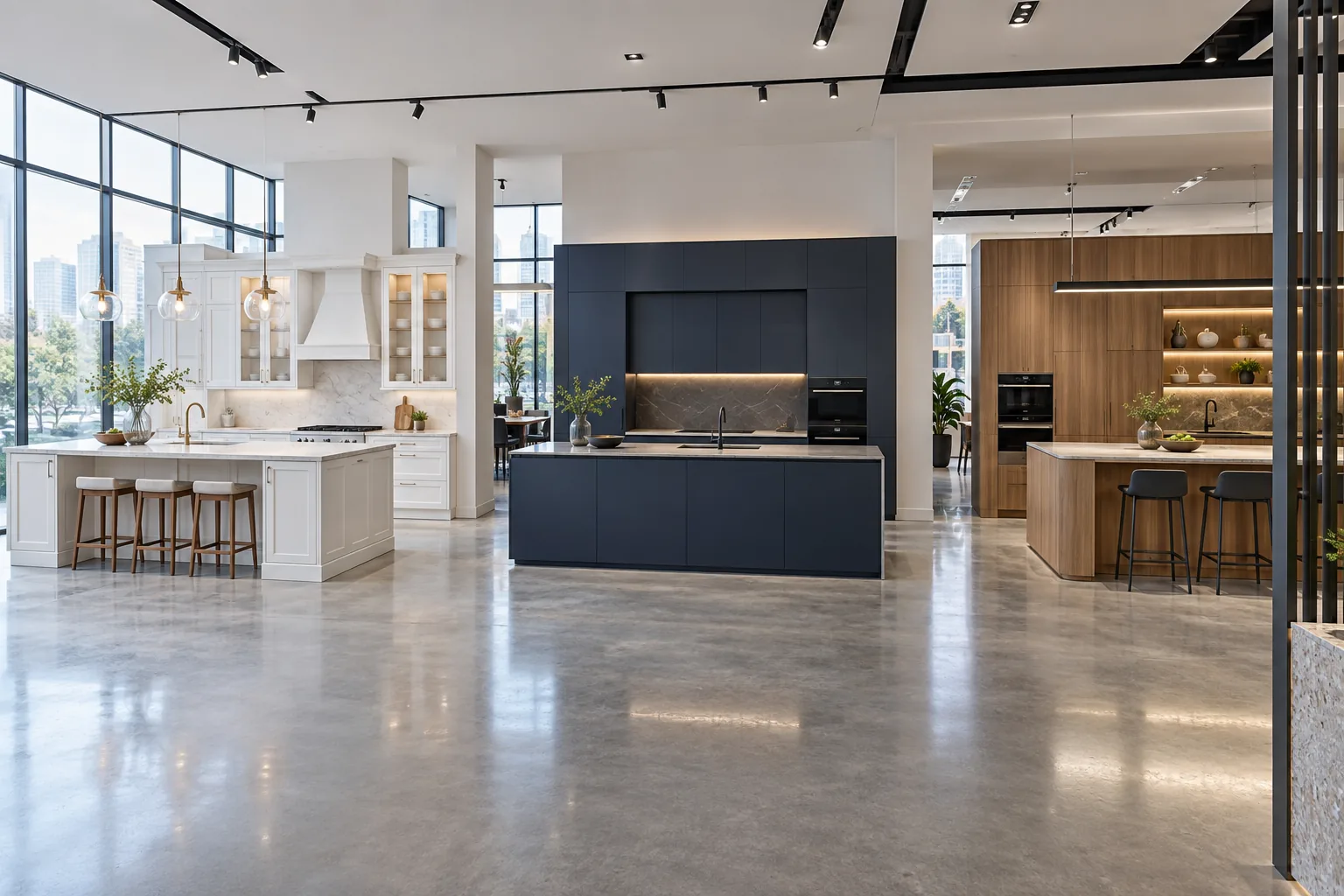
Why Buy Custom Cabinets from China
A good local custom shop can also build “any style, any size.” That is not the question. The question is what that flexibility costs you, and what comes with it. The case for China is structural, not promotional.
The Cost Structure
The price gap between a Chinese factory and a Western custom shop is not a mystery discount — it comes from identifiable layers. Manufacturing labor in China costs a fraction of shop labor in the US, Canada, or Western Europe. Every component — board, hardware, lacquer, glass, packaging — is sourced within the same industrial region, often within the same city, so there is no cross-border component logistics embedded in the cabinet price. And a factory-direct order removes the importer-distributor-dealer markup chain that a retail cabinet normally carries. We break down exactly where each dollar goes in our full price breakdown.
Customization Without the Custom-Shop Premium
In Western markets, “custom” is a pricing tier: the moment a dimension deviates from the catalog, the quote jumps, because a small shop must interrupt its standard workflow for your order. Chinese export factories run flexible production lines where non-standard widths, heights, and depths are routine — the line is set up per order anyway, so your 347mm-wide pull-out spice cabinet costs roughly what a standard one costs per unit. Customization stops being a surcharge and becomes the default.
The Supply Chain Ecosystem
Foshan and the wider Guangdong region concentrate the entire building-materials industry in one place: kitchen cabinets, windows and doors, tiles, sanitary ware, furniture, and lighting are all manufactured within the same cluster. For a project buyer, that means a whole-house material package can be sourced in one trip, consolidated into one container, and shipped as one order — something no single-factory country outside this ecosystem can practically offer.
Export Maturity
Export packaging, container loading, moisture protection, and room-by-room labeling for overseas delivery are mature, standardized practice in this industry — refined across decades of shipments to North America, Europe, Australia, and the Middle East. Buying cabinets from China in 2026 is not an experiment; it is a well-worn procurement route with established playbooks at every step.
| Factor | Local custom shop | Factory-direct from China |
|---|---|---|
| Cost structure | High local labor + showroom and dealer markups | Manufacturing labor + fully local component supply, no distribution layers |
| Non-standard sizes | Priced as one-off exceptions | Routine — lines are configured per order |
| Order scale | Optimized for single kitchens | Handles single kitchens through container-scale project runs |
| Category integration | Cabinets only; other trades sourced separately | Cabinets + windows, doors, tiles, sanitary ware, furniture in one consolidated order |
| Lead time composition | Production queue | Production + sea freight — planned together in the quotation |
| Minimum order | None, but priced retail | Order-level MOQ, flexible per project |
What You Can Customize
Every order is built to a confirmed drawing set. These are the five dimensions you control.
Door Styles
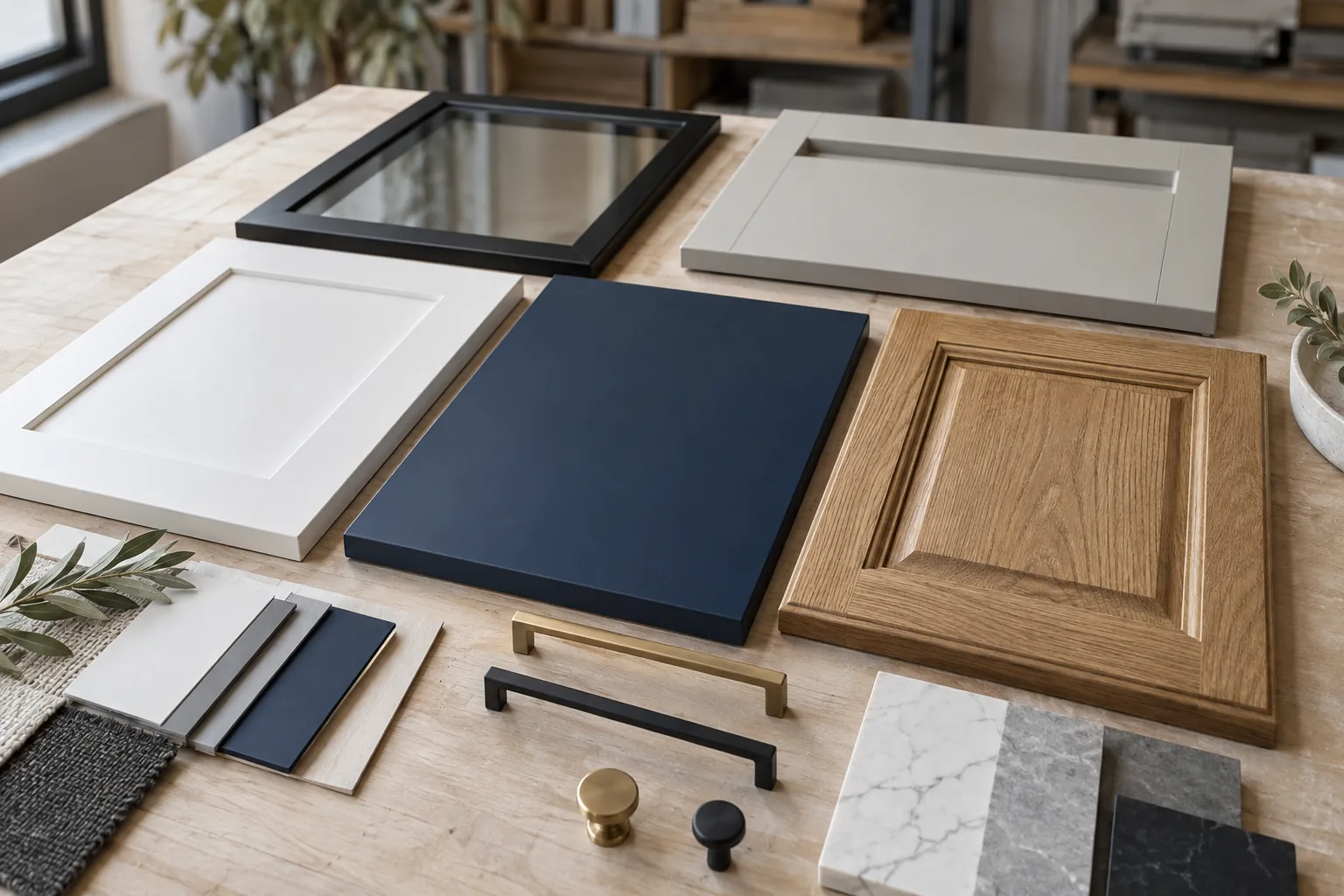
Shaker, flat-panel, raised-panel, glass-front, and handleless designs are all standard production for us — along with frame profiles, edge details, and groove patterns adjusted to your reference. If you are weighing the two most popular styles for a project, our data comparison of shaker and flat-panel cabinets covers cost, durability, and market preference in detail.
Materials
Carcass and door materials are specified per order: plywood, MDF, particle board, solid wood, and stainless steel for outdoor kitchens. The choice moves stability, moisture resistance, weight, and price in different directions — plywood carcasses with solid wood doors sit at the durable end of the range, while MDF with a quality lacquer finish delivers the smoothest painted surface at a friendlier price point. We recommend configurations by room and climate rather than by margin.
Finishes and Colors
Lacquer from matte to high-gloss, melamine, wood veneer, PET, and laminate finishes cover everything from rental-grade durability to showroom-grade gloss. Colors are matched to RAL or Pantone references, or to a physical sample you courier to the factory — a painted door sample is produced for your approval before the full run.
Sizes and Layouts
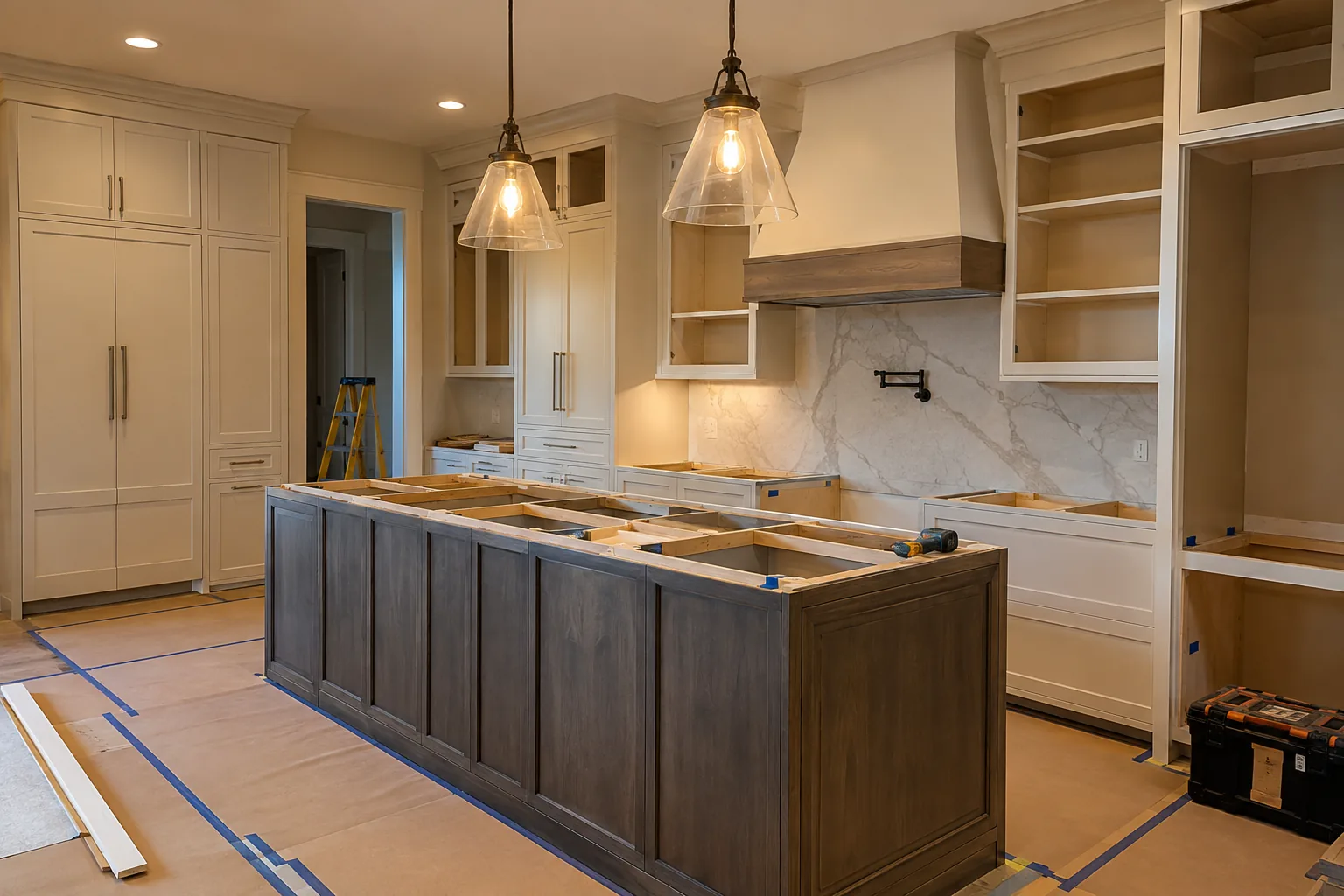
Cabinet widths, heights, and depths follow your plan, not a modulo system: non-standard runs, angled corner units, floor-to-ceiling tall cabinets, reduced-depth wall cabinets for tight galley kitchens, and island units in any footprint. We work from architect drawings, kitchen-planner exports, or hand sketches — whatever your project already has.
Hardware and Accessories
Hinges, drawer slides, lift systems, and pull-out baskets are quoted by brand tier — from reliable domestic hardware to premium European brands for soft-close and heavy-load applications. Interior lighting, waste-bin pull-outs, spice racks, and corner mechanisms are added per unit. The tier you choose is one of the clearest levers on the final price, and one of the easiest to adjust when balancing a budget.
| Dimension | Option range |
|---|---|
| Door style | Shaker, flat-panel, raised-panel, glass-front, handleless; custom profiles and edge details |
| Carcass material | Plywood, MDF, particle board, stainless steel (outdoor) |
| Door material | MDF (painted), solid wood, plywood, PET/laminate-faced board, glass |
| Finish | Lacquer (matte → high-gloss), melamine, wood veneer, PET, laminate |
| Color | Any RAL/Pantone reference or physical sample match, confirmed by pre-production door sample |
| Sizes & layout | Fully non-standard dimensions, corner/tall/island units, architect-plan-driven |
| Hardware | Domestic to premium European tiers; soft-close, pull-outs, lighting, organizers |
What Custom Means for Quality
Custom does not mean uncontrolled. A professional export order carries written specifications at every layer, and you should hold any supplier — us included — to them:
- Board emissions: panels are specified to CARB Phase 2 / EPA TSCA Title VI compliance for the US market, or the equivalent grade for your destination, stated in the order documents.
- Edge banding: laser or PUR edge banding on exposed edges, specified by finish type.
- Tolerances: dimensional tolerances are agreed in the shop drawings before production, not discovered on site.
- Pre-shipment inspection: test assembly of key units and photographic verification before packing.
If you are still evaluating suppliers, our guide on how to verify a cabinet factory before you order walks through the twelve checks that separate reliable manufacturers from risky ones.
After you place the order, our guide to kitchen cabinet quality control from China shows the four checkpoints that keep your shipment matching the sample.
What Custom Means for Price
Customization moves the price — but predictably, and mostly in directions you control. The table below shows which way each choice pushes, so you can design to a budget instead of discovering it in the quote.
| Custom choice | Price direction | Why |
|---|---|---|
| Solid wood doors instead of MDF | ↑ | Material cost plus finishing labor |
| High-gloss lacquer instead of melamine | ↑ | Multi-coat finishing and curing process |
| Premium branded hardware tier | ↑ | Component brand cost — the cleanest quality lever |
| Non-standard dimensions | ↑ slightly | Setup and material yield; usually modest at order scale |
| Larger order quantity | ↓ per unit | Line setup and packaging amortized across more units |
| Consolidated whole-house order | ↓ logistics | One container, one shipment, one customs entry |
How Ordering Works: Three Steps
No procurement course required — the path from idea to delivery is short, and you hold a deliverable at every step:
- 1. Send what you have. Drawings, planner exports, photos, or a written list. You receive a design proposal with an itemized quotation.
- 2. Confirm the details. You review 2D/3D confirmation drawings, door samples, and the final specification — and sign off before anything is cut.
- 3. We build and ship. Production, pre-shipment inspection with photo documentation, export packing, and container loading — with updates at each milestone. Our shipping guide for kitchen cabinets explains how that handoff works from factory to destination.
Furnishing more than a kitchen? Cabinet orders are routinely combined with windows, doors, tiles, and furniture into a single whole-house sourcing shipment from China — one supplier conversation, one container, one arrival.
Why George Group, Among Chinese Suppliers
China’s manufacturing advantages are real — but they come wrapped in a coordination problem: finding the factory, translating your drawings into production language, checking quality, and arranging freight are usually four separate relationships. George Group exists to collapse those into one.
One supplier for the whole house. We supply kitchen cabinets alongside windows, doors, tiles, sanitary ware, furniture, and lighting. The ecosystem advantage described above becomes a single point of contact: one quotation conversation, one consolidated container, one party accountable for the whole shipment.
Design service built in. Our design team produces the 2D/3D confirmation drawings your order is built from — you review and approve visuals and dimensions before production, instead of hoping a factory interpreted your sketch correctly.
See it before you buy it. Our factory and showroom in Foshan are open to visiting buyers, and we run live video walkthroughs for remote ones — materials, finishes, and production lines are inspectable, not just promised.
One accountable party. Quotation, quality control, packing, loading, and after-sales run through a single team that answers in your time zone. When something needs fixing, there is exactly one phone to ring.
Frequently Asked Questions
Is there a minimum order for custom cabinets?
Orders are priced per project rather than per fixed MOQ. A single kitchen is workable; multi-kitchen and whole-house projects get meaningfully better unit economics because setup, packing, and freight costs spread across more units. Your quotation will show the difference explicitly.
Can you build from my architect’s or designer’s drawings?
Yes — that is the most common starting point. CAD files, kitchen-planner exports, PDFs, and legible hand sketches all work. We return shop drawings for your confirmation, and production starts only after your written approval.
How do we confirm colors and finishes from overseas?
Three ways, usually combined: you specify RAL or Pantone references, you courier a physical sample for us to match, and we produce a finished door sample — photographed and, where timing allows, shipped — for approval before the full run.
How long does a custom order take?
Lead time has two parts: production (measured in weeks, depending on order size and finish complexity) and sea freight (depending on your destination port). Both are committed in writing in the quotation, with milestone updates during production.
Do non-standard sizes add a lot to the price?
Usually less than buyers expect. Because production lines are configured per order, non-standard dimensions are a modest setup consideration rather than a custom-shop surcharge — the larger cost levers are materials, finish grade, and hardware tier.
Can I get a sample before committing to a full order?
Yes. Sample doors and finish swatches are standard practice, and for project orders we can discuss pilot units. Sample costs and courier arrangements are quoted separately so you can decide with full information.
Sources and editorial notes: product ranges and service descriptions reference George Group’s published catalog and design service pages. Emissions standards are cited by name (CARB Phase 2; EPA TSCA Title VI) — confirm destination-market requirements with your local certifier. Quotations are project-specific; nothing in this article substitutes for a written quote.