

Kitchen Cabinet Shipping & Logistics
Last reviewed: September 2026
You approved the samples. The price is settled, the quality checks passed. And then your cabinets still have to cross an ocean — thirty days of humidity, salt air, crane lifts, and forklift forks between the factory floor and your project site. That last stretch is where well-made cabinets are won or lost, and it is the part buyers ask us about most once the order itself is agreed. This article covers the three decisions that determine how your order arrives: how it is packed, which shipping term you sign, and what happens if something goes wrong anyway.
Quick answer — how your cabinets arrive the way they left:
- Two packing formats: flat-pack (RTA) maximizes container space and minimizes freight per cabinet; assembled shipping trades space for zero on-site assembly time. The right choice depends on your order structure.
- Three shipping terms: FOB, CIF, and DDP divide cost and risk differently between you and the supplier. You pick the one that matches your importing experience — not the one the supplier defaults to.
- One accountable party: when the team that built your cabinets also packs, loads, and books them, a damage claim has exactly one owner — and one phone number to call.
Everything below applies to the full range in our custom kitchen cabinets catalog — every series ships under the same packing and loading discipline.
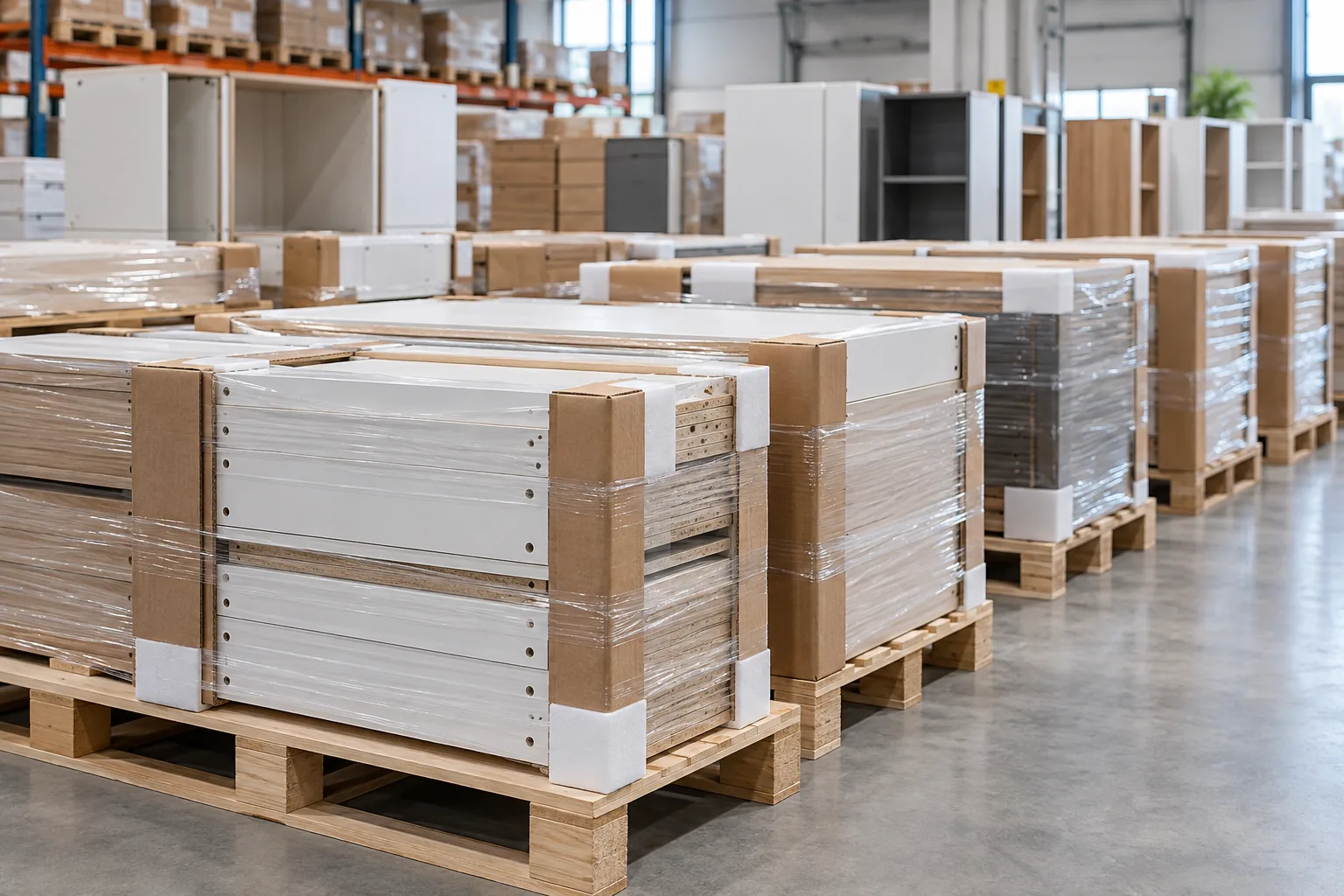
Flat Pack vs Assembled: How Your Cabinets Travel
Before anything is wrapped, one decision shapes everything downstream: do your cabinets travel as furniture or as panels? Both are legitimate answers — for different orders.
Flat Pack (RTA): Maximum Cabinets per Container
Ready-to-assemble cabinets ship as machined panels, doors, and hardware kits in flat cartons. A 40-foot container holds several times more flat-packed kitchens than assembled ones, which means the freight cost per cabinet drops sharply — the single biggest lever on your landed logistics cost. Panels also travel well: flat cartons stack tight, present no protruding hinges or handles, and spread load evenly. What you receive: compact, labeled cartons that any local installer assembles with standard tools, each kit matching one unit on your packing list.
Assembled: Installation-Ready on Arrival
Assembled cabinets leave the factory as finished units — carcass, doors hung and aligned, drawers fitted. They take far more container space and need more protective material per unit, but they arrive ready to set in place. For a tight project schedule with no local assembly capacity, the saved installation hours can outweigh the extra freight. What you receive: cabinets your crew positions, levels, and fixes — no cam locks, no instruction sheets, no missing-dowel surprises.
How to Choose
The decision follows your order structure, not preference. Project and distributor volume almost always ships flat-pack — the freight math is decisive at scale. Smaller orders, show kitchens, or sites with no assembly labor lean assembled. Mixed orders are normal: assembled tall units, flat-pack wall and base cabinets. Non-standard dimensions affect this choice too, since oversized custom units change how a container is planned — something we settle during the design stage for non-standard sizes and custom orders.
The two formats at a glance:
| Flat Pack (RTA) | Assembled | |
|---|---|---|
| Container efficiency | High — several times more kitchens per 40ft container | Low — finished volume ships with air inside |
| Freight per cabinet | Lowest | Higher, plus more protective material |
| Transit risk profile | Flat, dense cartons; few exposed surfaces | Finished surfaces exposed; needs more bracing |
| On arrival | Local assembly required (installer or crew) | Installation-ready — position, level, fix |
| Best for | Project volume, distributors, repeat orders | Tight schedules, small orders, no local assembly labor |
Packaging That Survives 30 Days at Sea
A container crossing the Pacific is not a gentle environment. Cartons are crane-lifted, stacked under tons of load, and parked for weeks in air humid enough to condense on metal. Export packaging exists so that none of this reaches your cabinets — and it is engineered in layers.
Unit-level protection. Panels and doors get foam or honeycomb corner protectors, edge guards, and full stretch-wrap; finished faces are separated by protective sheet so nothing rubs in transit. Cartons are double-wall export grade, rated for stacking weight — not the domestic cartons a factory uses for its local deliveries. This distinction matters more than any single material: the failure mode of cheap export packing is not one dramatic crush, it is a thousand small rubs that leave every door edge polished white.
Moisture and salt defense. Thirty days of sea air attacks two things: board edges and hardware. Cartons are sealed with waterproof tape, desiccant goes inside the container, and hardware kits are bagged so hinges and slides arrive without the surface corrosion that turns a smooth drawer gritty. What you see on arrival: cartons that open dry, boards with factory-crisp edges, hardware that looks the way it did in the factory photos.
Container-level engineering. Inside the container, cartons are palletized or floor-loaded in a planned pattern, then braced with airbags and strapping so the load cannot shift when the ship rolls. Loading is photographed as it happens — you see your cartons going in, row by row, before the doors close.
Labeling that keeps your order intact. Every carton carries your project reference, room and unit codes, and a carton number tied to the packing list — not generic marks. When the container arrives, carton 47 of 63 is identifiable as the tall unit for kitchen block B, and a missing or damaged carton is identifiable in minutes rather than after a full unpack.
None of this replaces what happens before packing: your order is already inspected and approved before packing begins. Packaging’s only job is to make sure “approved” is the condition that arrives.

FOB, CIF, or DDP: Who Owns the Risk
Shipping terms — the Incoterms published by the International Chamber of Commerce — decide who pays for each leg of the journey and, more importantly, who owns the risk at each point. Three terms cover nearly every cabinet order from China. This is not a vocabulary lesson; it is the decision of how much of the logistics chain you want to run yourself.
FOB — You Run the Ocean Leg
Under FOB, the supplier delivers your order loaded onto the vessel at the Chinese port. From that moment, freight, insurance, and risk are yours, arranged through your own forwarder. Experienced importers with an established forwarder relationship often prefer it — they control carrier choice and see their true freight cost directly. What it means for you: maximum control, and maximum homework.
CIF — We Book, the Sea Is Still Yours
Under CIF, the supplier arranges and pays ocean freight and insurance to your destination port — you receive a shipment that simply arrives at your harbor, with marine insurance attached. Risk still transfers at loading, but the insurance travels with the goods, which is exactly what the damage-claim section below relies on. What it means for you: the mainstream choice — one booking instead of two, no forwarder needed on your side, customs clearance at destination remains yours.
DDP — Door to Door, Nothing Left for You
Under DDP, the supplier’s chain runs all the way to your address: ocean freight, destination port handling, customs clearance, duties, and final trucking are all arranged and paid by the seller side. For first-time importers, or buyers without a customs broker, it converts international shipping into something that behaves like a domestic delivery. What it means for you: one price, one responsible party, no customs learning curve.
| FOB | CIF | DDP | |
|---|---|---|---|
| Who books ocean freight | You (your forwarder) | Supplier | Supplier |
| Who pays freight + insurance | You | Supplier | Supplier |
| Risk transfers to you | Once loaded on vessel in China | Once loaded on vessel (insured) | On delivery at your address |
| Customs clearance at destination | You | You | Supplier |
| Best for | Experienced importers with a forwarder | Most buyers — the default sweet spot | First-time importers, no broker, want it turnkey |
Which term you sign also decides where your money goes at each stage — freight, insurance, duties, and port fees all sit under different columns depending on the term. For how those line items add up into your total, see the landed cost breakdown for kitchen cabinets from China.
Timeline: From Factory Floor to Your Port
Buyers planning a project around a cabinet shipment need one thing above all: a schedule they can build backward from. Ocean freight is predictable in structure even when exact dates flex, and the structure looks like this:
| Stage | Typical Duration | What Happens |
|---|---|---|
| Booking & documentation | ~1 week | Vessel space booked; packing list, commercial invoice, and export documents prepared |
| Loading & customs export | 2–4 days | Container loaded and photographed, sealed, cleared for export |
| Ocean transit — US West Coast | ~2–3 weeks | Direct sailings from South China ports |
| Ocean transit — US East Coast | ~4–5 weeks | Via canal or transshipment |
| Ocean transit — Europe / Middle East / Australia | ~3–5 weeks | Varies by port; your quote states the routing |
| Arrival notice & pickup | Days before docking | Your forwarder (or ours, under DDP) is notified; pickup or delivery arranged |
Peak seasons and port congestion can stretch any individual leg, which is why project orders should be scheduled with buffer rather than against a best-case date. What you can hold a supplier to is the process: booking confirmed in writing, loading photographed, tracking shared, arrival notice forwarded. With those in hand, you are managing a schedule — not waiting for a surprise.

If Something Arrives Damaged
Serious suppliers are not the ones who claim damage never happens — they are the ones with a written process for when it does. Ours runs in three steps, and the time to understand it is before you sign, not after you unpack.
Step 1 — Inspect at receipt, on the record. When the container or delivery arrives, check carton condition before signing anything clean: crushed corners, water staining, broken shrink-wrap get photographed at the truck or dock, with the carton numbers visible. External damage noted at receipt is what separates a clean claim from an argument later.
Step 2 — Report within the agreed window. Open suspect cartons first, photograph contents before moving anything, and report within the notification window in your order documents (48 hours is the common industry standard for visible damage). Because every carton is numbered against the packing list, a claim names exact cartons and units — “cartons 12 and 31, block B tall units” — not “some of the order.”
Step 3 — Resolution through one channel. Under CIF and DDP, insured transit damage follows the marine insurance claim path, with the supplier’s team preparing the documentation the insurer requires. Manufacturing-side issues and missing items follow the replacement path — remade parts shipped with your next order or by express for project-critical pieces. Either way, you deal with one contact who already has your order file, not a triangle of factory, forwarder, and insurer each pointing at the others.
| Step | Window | What You Do | Who Owns It |
|---|---|---|---|
| 1. Receipt inspection | At delivery, before signing | Photograph damaged cartons with numbers visible; note damage on the delivery receipt | You + driver/dock witness |
| 2. Damage report | Within the agreed window (48h standard for visible damage) | Send photos and carton numbers; we verify against the packing list and loading photos | You report, we document |
| 3. Claim or replacement | Per order terms | Confirm resolution — insurance claim (insured transit damage) or replacement parts (manufacturing side) | We run it end to end |
The loading photos from step two of your order’s journey exist precisely for this moment: when a claim is opened, both sides are looking at the same evidence, from the same file.
Shipping with George Group
The disciplines above are industry standard. What working with George Group adds is that they run as one continuous chain, under one roof:
One accountable party, factory to port. The team that built your cabinets packs them, loads them, books them, and tracks them. Your order file — drawings, QC photos, packing list, loading photos, documents — lives in one place, with one contact. If anything ever goes wrong, there is no hand-off to hide inside.
Whole-house orders consolidate into one container plan. If your project bundles cabinets with windows, doors, tiles, or stone, everything ships under one loading plan instead of four suppliers each sending their own half-empty container. Consolidation is where multi-category orders save the most on freight — and where a single-item damage claim does not strand the rest of your order.
Loading is documented as standard. Carton counts, loading rows, bracing, and the sealed container are photographed for every order and sent to you — the same evidence chain our QC process starts, carried through to the moment the doors close.
Terms that match your setup. FOB if you have a forwarder you trust, CIF for the mainstream route, DDP if you want it turnkey. If you are weighing your first China order, we will walk through which term fits before you commit to anything.
And if you would rather see all of this in person — the packing lines, the loading bay, the warehouse — a factory visit fits naturally around the Canton Fair season; our Canton Fair sourcing guide covers how buyers combine the fair with a Foshan factory tour.
Frequently Asked Questions
How many kitchens fit in one container?
Flat-pack is what makes container math friendly: a 40-foot container typically holds the cabinetry for a multi-unit project rather than a handful of kitchens — often an order of magnitude more than the same cabinets assembled. The exact count depends on your unit mix and sizes, so we calculate it from your actual packing list during quoting rather than quoting a generic number.
How long does shipping take, realistically?
Plan on roughly 2–3 weeks on the water to the US West Coast, 4–5 to the US East Coast, and 3–5 weeks to Europe, the Middle East, or Australia — plus about a week for booking, loading, and export clearance before departure. Add buffer for peak season. We confirm the routing and expected window in writing when your order ships.
Who pays if cabinets arrive damaged?
It depends on where the damage occurred, and your shipping term determines which mechanism applies. Insured transit damage under CIF or DDP goes through the marine insurance claim, which we prepare and run. Manufacturing-side issues are resolved by replacement directly with us. What never changes: you report to one contact, and that contact owns the resolution.
I have never imported before — can I still order?
Yes — that is exactly what DDP exists for. Under DDP we handle ocean freight, destination customs clearance, duties, and delivery to your address; the shipment behaves like a domestic delivery. Many first-time buyers start DDP and move to CIF or FOB once they have a forwarder and broker they like.
Do you ship full containers only, or can I combine orders?
Both. Full container loads (FCL) are the norm for project orders. Smaller orders can ship as less-than-container load (LCL), and multi-category whole-house orders are consolidated into a shared container plan when volume justifies it. We recommend whichever structure the math favors for your specific order.
Can packaging be upgraded for my destination?
Yes. Humid or long-route destinations can get upgraded moisture protection; fragile or high-gloss finishes can get wooden crating on top of standard export cartons. Packaging spec is agreed with your order documents, so the protection level is a written line item — not a verbal promise.
Sources and editorial notes: packing, loading, and claims practices described reflect standard export manufacturing discipline; trade terms follow the Incoterms® rules published by the International Chamber of Commerce. Transit times are industry-typical ranges — your confirmed routing and schedule are stated in your order documents. Nothing here substitutes for your written contract and quotation.