

Wholesale Kitchen Cabinets
Last reviewed: September 2026
If you buy cabinets by the container rather than by the kitchen, the question is never “where is it cheapest” — it is “how much of the price is the cabinet, and how much is the chain of hands it passed through.” Buying wholesale kitchen cabinets from China removes most of that chain: you are dealing with the factory that cuts the panels, not an importer, a master distributor, and a regional wholesaler each adding their margin along the way. This article lays out what factory-direct wholesale buying actually gets you, what it asks of you in return, and how volume orders stay consistent from the first unit to the five-hundredth.
Quick answer — what wholesale from China comes down to:
- Who it fits: importers and distributors, contractors and developers with project volume, and retail chains — anyone whose order fills a container, not a pickup truck.
- What you get: volume-tier factory pricing with no middleman margins, full custom specifications even at scale, and one accountable party from quotation to delivery.
- What it usually asks: most factories set minimum order quantities — though some (George Group included) accept custom orders of any size by consolidating smaller shipments, so volume is an advantage, not a barrier.
The ranges this applies to are in our custom kitchen cabinets catalog — every series there is available for volume orders under the terms below.
Who Buys Cabinets Wholesale — and When China Wins
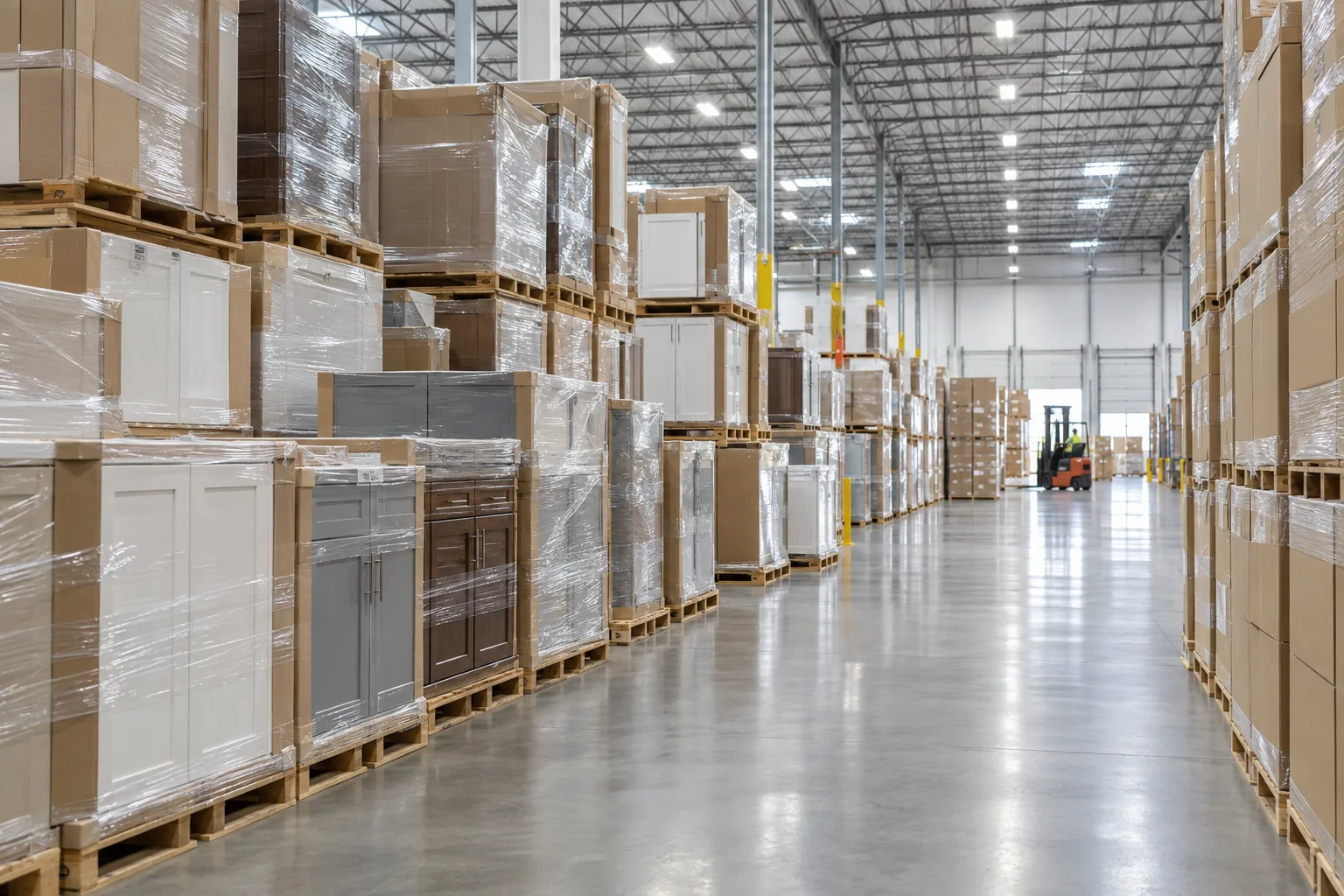
Wholesale is not one kind of buyer. The four groups below all buy in volume, but they come with different order shapes — and the fit with China sourcing differs with each.
| Buyer Type | Typical Order Shape | Fit with China Sourcing |
|---|---|---|
| Importers & distributors | Repeat container orders across a fixed catalog; stock and resell | Strongest fit — factory-direct margin is the whole business model; repeatability matters most |
| Contractors & developers | Project batches — dozens to hundreds of kitchens to one spec package | Strong fit — one design package replicated at scale is exactly what production lines do best |
| Retail chains & showrooms | Mixed SKU orders, display units plus stock; private label common | Good fit — OEM/ODM production and mixed-model container loading are standard practice |
| Small studios & remodelers | A few kitchens per month, varied specs | Workable with the right supplier — consolidated (LCL) shipping removes the container-scale barrier; freight per unit runs higher, but the door is open |
When a Local Wholesaler Is the Better Call
Honesty first, because it defines the boundary: if you need ten kitchens this Friday, or your clients demand next-day replacement doors off a shelf, a local wholesaler’s warehouse beats any ocean freight math. China sourcing wins everywhere else: when you can plan a quarter ahead, when the same specification repeats — and, with suppliers who consolidate smaller shipments, even when your order is a single custom kitchen rather than a full container.
Notice what wholesale buyers actually compare once they are past the first order: not the sticker price of a cabinet, but landed cost per unit, batch-to-batch consistency, and whether reordering the same kitchen six months later produces the same kitchen. Those three things — not price alone — are what the rest of this article is about.
What Factory-Direct Actually Gets You
Volume Pricing Without the Stacked Margins
A cabinet bought through a domestic wholesaler carries the factory price plus the exporter’s margin, the importer’s margin, the distributor’s warehouse cost, and the wholesaler’s markup — each layer typically charging for the same cabinet again. Factory-direct collapses that chain to one transaction. On top of that, volume itself lowers the factory’s cost per unit: materials are purchased in bulk, production runs longer without changeovers, and packing is standardized. That is why wholesale quotes step down in tiers as quantity rises — the savings are structural, not negotiated theater. For how those line items stack into your final landed cost, see how pricing works for kitchen cabinets from China.
No Specification Compromise at Scale
“Wholesale” does not mean picking from a fixed catalog of whatever the factory overproduced. Volume orders from a custom factory carry the same specification freedom as a single bespoke kitchen: door styles, finishes, carcass materials, hardware tiers, non-standard dimensions — all locked in your order documents and replicated across every unit. Bulk buyers regularly mix multiple door styles and colors inside one container to serve different projects or SKUs. If you want to see the full range of what can be specified, our guide to custom specifications for kitchen cabinets from China covers it in detail.
One Accountable Chain
The middlemen that disappear from the price also disappear from the blame chain. When your quotation, production, inspection, packing, and shipping are handled by one team, a problem has exactly one owner. Anyone who has chased a defect through “the wholesaler blames the importer, the importer blames the factory” knows what that is worth — usually discovered too late, and priced in everywhere.
MOQ and Order Structure
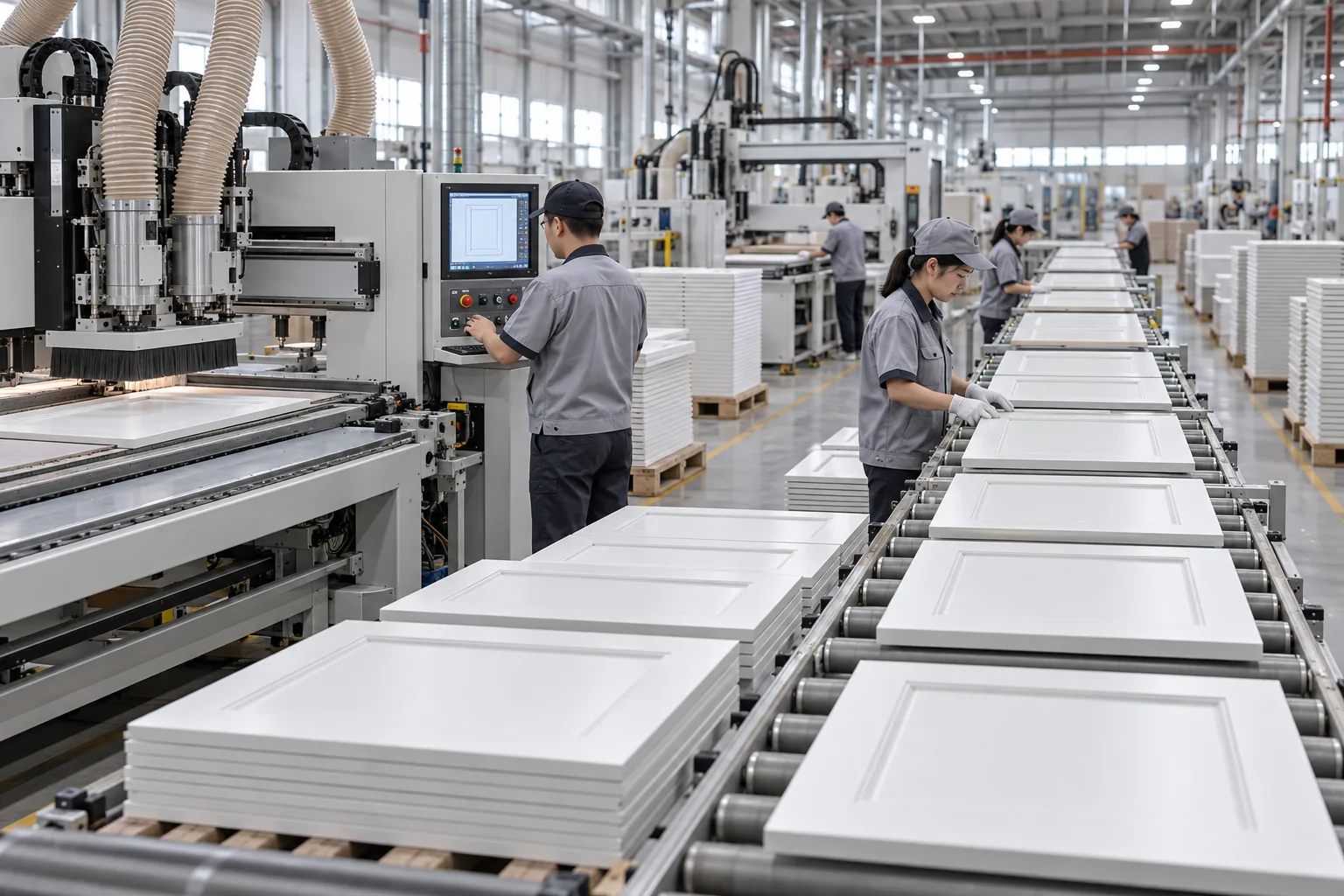
Minimum order quantities exist for a boring, physical reason: a production line has setup costs, and a container has a fixed volume. Below a certain quantity, the factory’s setup time and the buyer’s freight per unit both stop making sense — for both sides. MOQs in the industry are typically structured per model or per order rather than per single cabinet, and mixed-model orders usually count toward the total. The exact threshold depends on your specification and is always stated in the quotation — treat any supplier who will not put it in writing as a warning sign, not a bargain.
That said, MOQ is a factory-policy answer to a logistics problem — and there is another answer to the same problem. George Group sets no MOQ at all: a single fully-custom kitchen is accepted the same way a container order is, because smaller orders are consolidated with other shipments (LCL) instead of each buyer having to fill a container alone. The trade-off is transparent: consolidated freight costs more per unit than a full container, so volume still pays — but the entry barrier is gone, and a first trial order can be exactly as small as you need it to be.
What matters more than the number is the flexibility around it. Serious factory-direct suppliers structure wholesale orders with:
- Mixed SKUs in one container — several door styles, finishes, and cabinet types combined to fill the load, so one project or one retail line ships together.
- Split shipments — large framework orders delivered in phased batches matched to your project schedule or warehouse capacity.
- Repeat-order frameworks — your specification kept on file so reordering six months later is a confirmation, not a new negotiation.
- Private label / OEM — your brand on the cartons and documents, standard practice for distributors and chains.
Whatever structure you choose, the quality of the answer you get depends on the quality of the inquiry you send. A request for quotation that can be quoted accurately — and compared honestly against other suppliers — contains these elements:
| RFQ Element | Why It Matters | What Good Looks Like |
|---|---|---|
| Quantity & mix | Drives the pricing tier and container plan | Units per model, or kitchens per project — not “a container’s worth” |
| Specification package | The quote is only as real as the spec | Door style, finish, carcass material, hardware tier, dimensions or drawings |
| Destination & term | Freight, insurance, and duties change the total | Port or address, plus your preferred shipping term (FOB/CIF/DDP) |
| Timeline | Determines production slot and sailing schedule | Your required delivery window, stated honestly |
| Labeling & documents | Customs and receiving depend on it | Private label needs, destination-market document requirements |
Send these five things and the quote you receive is a number you can act on. Send “best price for kitchen cabinets” and the number you receive is a guess — one that will be revised upward later, when it costs you more.
Quality and Logistics at Volume
The two fears specific to bulk orders: “will unit 500 match unit 1?” and “what does a container of cabinets actually cost me to move?” Both have mechanical answers.
Batch consistency. Volume orders are not inspected by sampling goodwill — they are controlled by locking the specification at the front and verifying against it at defined checkpoints: incoming materials, first-article inspection at the production line, trial assembly, and pre-shipment checks with photo and video evidence you review before anything is packed. Consistency across hundreds of units is a process outcome, not a promise. The full checkpoint system is laid out in our guide to batch consistency and quality inspection for cabinets from China.
Container economics. Wholesale orders are naturally full-container loads, which is where freight per cabinet hits its floor — flat-packed volume orders fill a container’s rated capacity instead of shipping air. Packing, bracing, and documentation scale with the order without changing their discipline. The mechanics are covered in our guide to container shipping for kitchen cabinets from China.
The two buying modes side by side:
| Wholesale from China (Factory-Direct) | Buying from a Local Wholesaler | |
|---|---|---|
| Price structure | Factory price + shipping; volume tiers | Factory price + stacked middleman margins |
| Customization | Full specification freedom, even at scale | Whatever is in the warehouse catalog |
| Minimum order | Container-scale MOQ at most factories; none at George Group (small orders ship consolidated) | None — single units |
| Lead time | Production + ocean transit; planned quarterly | Days, from stock |
| Consistency across reorders | Spec on file, replicated by production line | Depends on the wholesaler’s current stock source |
| Best for | Distributors, project volume, retail chains | Urgent small orders, no-storage buyers |
Wholesale Ordering with George Group
Everything above is how factory-direct wholesale works when it works properly. Here is what it looks like specifically with George Group:
No minimum order, genuinely. One custom kitchen or one hundred containers — both are accepted, because smaller orders are consolidated with other shipments instead of being turned away. Wholesale pricing still rewards volume, but nobody is locked out of factory-direct buying for being small. A trial order can be exactly as small as you need it to be.
Whole-house volume in one order. If your projects bundle cabinets with wardrobes, windows, doors, tiles, or stone, everything consolidates into one order file, one container plan, and one accountable team — the margin advantage of factory-direct applied across your entire material list, not just the kitchen line.
Specification locked before production. Our design team produces confirmation drawings and door samples you approve in writing before manufacturing begins, so the five-hundredth unit is made against the same signed document as the first.
Evidence at every stage. Trial assembly and pre-shipment inspections are photographed and filmed; container loading is documented row by row. You review your order remotely with the same confidence as standing in the factory.
Terms that fit your operation. FOB if you run your own freight, CIF for the standard route, DDP if you want delivery to your door with clearance handled. OEM and private-label documentation are standard for distributor programs.

Frequently Asked Questions
What is the minimum order quantity?
At most factories, MOQs are structured per model or per order, with the threshold stated in the quotation. At George Group there is no MOQ at all: fully custom orders of any size are accepted, and smaller orders travel consolidated (LCL) rather than being refused. Consolidated freight costs more per unit than a full container, so volume still pays — but the entry barrier is gone.
Can I place a trial order before committing to volume?
Yes, and most wholesale relationships start exactly that way — a smaller first order that lets you verify quality, packing, documentation, and communication before scaling. Sample doors and material swatches can also be arranged ahead of any order so the specification is confirmed physically, not from photos.
Can wholesale orders still be customized?
Fully. Volume does not lock you into a catalog: door styles, finishes, carcass materials, hardware tiers, and non-standard dimensions are all specifiable, and multiple designs can be mixed in one container. Customization at scale is the norm for project and distributor orders, not the exception.
How long does a wholesale order take?
The timeline has two parts: production (scheduled when your order is confirmed — larger orders get a written production schedule) and ocean transit, which runs roughly two to five weeks depending on your destination. Plan quarterly rather than weekly and the schedule is highly predictable; your order documents state the confirmed timeline.
How do you keep unit 500 identical to unit 1?
By anchoring both ends of production to the same signed specification: approved samples and drawings at the front, then checkpoint inspections — incoming materials, first-article, trial assembly, pre-shipment — measuring the run against that specification, with photo and video evidence sent to you. Consistency is enforced by process, not promised by slogan.
Do you support OEM / private label?
Yes — your branding on cartons, labels, and shipping documents is standard for distributor and retail-chain programs. Tell us your labeling requirements in the RFQ and they are written into the order.
Sources and editorial notes: wholesale structures, MOQ logic, and ordering practices described reflect standard export manufacturing practice; specific quantities, tiers, and timelines are always as stated in your written quotation and order documents. Nothing here substitutes for your contract.