

Quick answer: Choose a custom cabinet manufacturer only after the supplier can put its factory identity, board specification, hardware model, inspection plan, and contract responsibilities in writing. A low headline price is meaningful only when those five items refer to the same specification.
This guide is for importers, developers, contractors, designers, and homeowners placing a custom kitchen-cabinet order. It is most useful when you are comparing two or more quotations. It is not a substitute for local code advice or independent testing where your project requires it.
If you are evaluating a broader project, start with George Group for an overview of the product categories and sourcing support available. For supplier comparison context, see our guide to kitchen cabinet manufacturers in China. Before approving a specification, compare the intended construction and finishes with the kitchen cabinet collection. If you are still weighing door styles, our shaker vs flat-panel kitchen cabinets comparison covers cost, cleaning, and resale trade-offs.
| Check | What to request | What a usable answer looks like |
|---|---|---|
| 1. Supplier type | Live workshop walkthrough | A current video call that shows the relevant production area and who manages it. |
| 2. Product scope | Recent comparable project | Photos, drawings, and finish samples for a cabinet type close to yours. |
| 3. Board specification | Mill, material, thickness, and finish | Each line is named in the quotation rather than described as “standard board.” |
| 4. Compliance | Market-specific test and certification records | The report identifies the product, test method, date, and issuing body. |
| 5. Door finish | A current finish sample | The sample is labeled with the same code used in the quotation. |
| 6. Hardware | Brand and model number | Hinges, runners, lifts, and accessories are listed individually. |
| 7. Edge treatment | Edge-banding method and exposed-edge details | The supplier explains the process and provides a close-up sample. |
| 8. Engineering | Approved shop drawings | Dimensions, fillers, appliance clearances, and service openings are signed off. |
| 9. Capacity | Production plan for your order | A realistic sequence for drawings, samples, production, inspection, and packing. |
| 10. Inspection | Written inspection plan | Acceptance criteria, sample size, defect categories, and remedy are agreed before production. |
| 11. Packing | Carton and pallet specification | Cabinet parts, glass, stone, and hardware are protected and labeled separately; see what happens after your order ships for the loading and delivery process. |
| 12. Contract | Signed commercial terms | Materials, Incoterms, payment stages, change control, and claims process match the final quotation. |
How the 12 checks are distributed across an order
A practical review sequence for comparing suppliers and reducing last-minute surprises.
1. Establish whether you are speaking with a factory, a trading company, or both
A factory and a trading company can both be useful partners. That distinction is not a verdict on quality; it clarifies who controls materials, engineering, production scheduling, and corrective action. For a cabinet order with unusual finishes, multiple units, or tight installation requirements, ask who owns each step before comparing quotations.
Start with a live walkthrough during working hours. Ask to see the product type closest to yours, the board-storage area, edge-banding equipment, assembly area, and packing area. A pre-recorded factory video can still be helpful, but it does not answer who is handling your order today.
2. Read a cabinet quotation as a specification, not a sales document
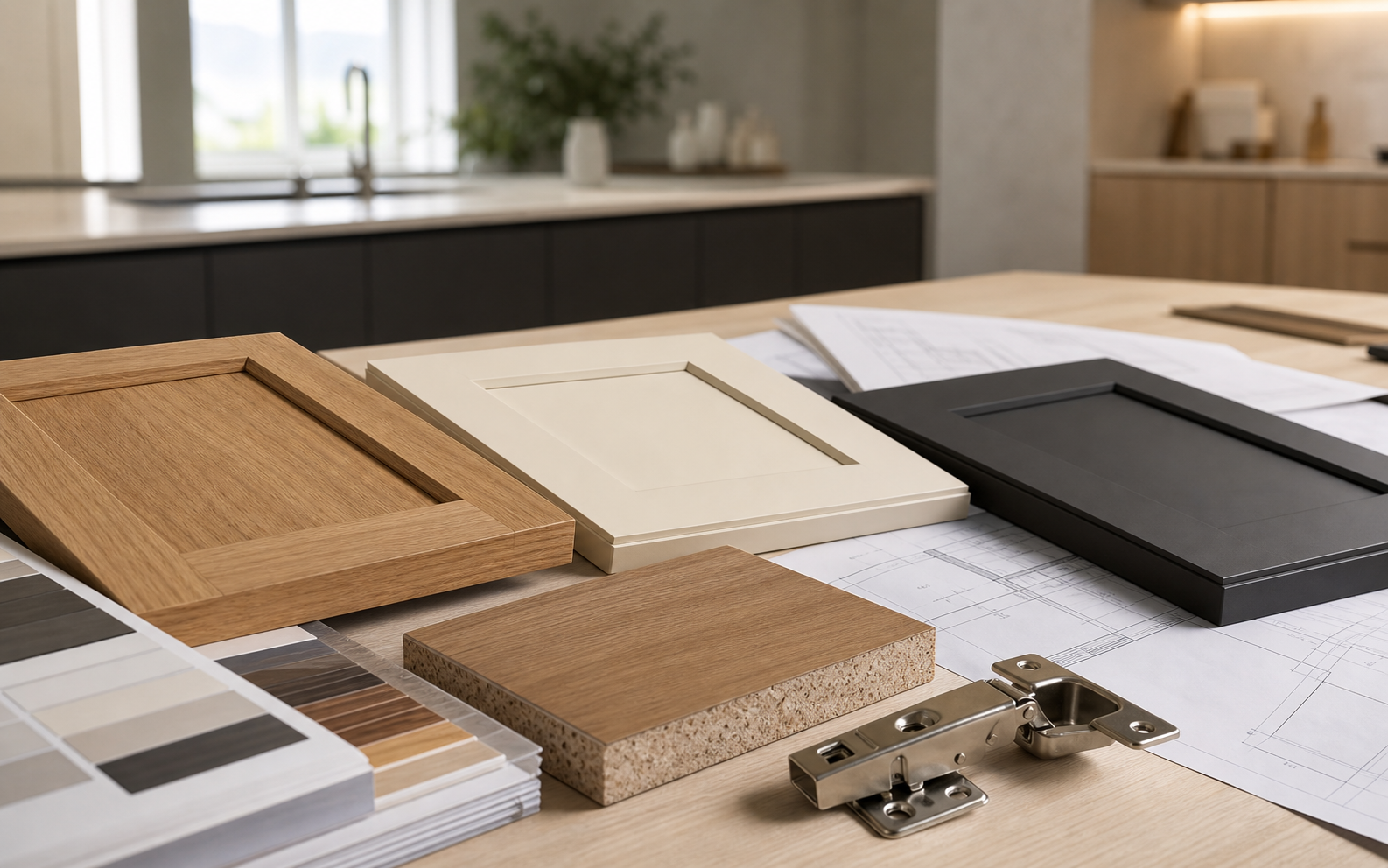
A serious quotation lets a buyer compare like for like. It should name the cabinet carcass material, door construction, surface finish, thickness, hardware, countertop scope where included, and packing. “Soft-close hardware” and “premium board” are descriptions, not specifications. For a cost-focused comparison, see our kitchen cabinets from China price breakdown.
For a kitchen project, create one shared comparison sheet and place each supplier’s answer in the same columns. Differences then become visible: a lower bid may exclude panels, fillers, internal accessories, installation drawings, or the finish sample approval process.
3. Check composite-wood compliance for the destination market
For United States-bound products containing particleboard, MDF, or hardwood plywood, ask how the supplier documents compliance with EPA TSCA Title VI composite-wood formaldehyde rules. The requested documentation should relate to the materials in your order, not a generic certificate image.
| Order stage | Evidence to collect | Why it matters |
|---|---|---|
| Quotation | Panel type and board supplier named | Creates a reference for material substitution control. |
| Pre-production | Applicable test/certification records and finish sample | Lets the buyer review the specified material before mass production. |
| In production | Batch traceability and approved change record | Connects the finished product to the agreed specification. |
| Pre-shipment | Inspection report and packing list | Supports an evidence-based release decision. |
Do not compare emission figures across standards unless the test method and unit are the same. If the project has a required standard, write that requirement into the purchase documentation and request the supporting record before the production release.
4. Treat hardware and edge treatment as service-life decisions
Cabinet doors and drawers are used every day, so the hardware line needs more than a brand name. Request the hinge, runner, lift, and pull-out model numbers, then confirm the intended load and cabinet configuration. If a supplier proposes an equivalent substitution, require written approval before it is used.
Also inspect a real edge sample. Look at the inside corner of a sink cabinet, the edge near an appliance, and a light-colored door under direct light. These are the areas where poor sealing, color mismatch, or rough trimming tend to show up first after installation.
5. Approve drawings before production, not after packing
Most expensive cabinet mistakes are coordination mistakes: a tall unit blocks a switch, a refrigerator clearance disappears, a filler is missing, or a plumbing opening is in the wrong place. Ask for shop drawings that show elevations, cabinet codes, dimensions, appliance assumptions, and any site-measured constraints.
For a mixed building-material order, keep cabinet drawings connected to the countertop, tiles, doors, lighting, and sanitary selections. George Group’s product range can help buyers map these related categories, while its kitchen cabinet collection is an appropriate starting point for cabinet configurations and finishes.
6. Make inspection criteria part of the order
Inspection works best when both sides agree on what will be checked before a product reaches the packing line. Set the inspection timing, the defect definitions, the sample plan, the accepted finish sample, and the correction process in advance. If you use an AQL-based plan, identify the edition and inspection level in the agreement; ISO 2859-1 explains the sampling framework, but it does not replace project-specific acceptance criteria.
For cabinets, inspect dimensions, door and drawer alignment, finish consistency, edge quality, drilling accuracy, hardware operation, labeling, and packing. A video of a completed cabinet is useful evidence, but it should supplement—not replace—the agreed inspection record.
7. Build a schedule that includes decisions, not just factory days
Ask the supplier to separate the schedule into drawing approval, finish-sample approval, material preparation, production, inspection, packing, and shipment readiness. That makes it easier to identify which buyer decisions are holding the order and which delays are inside the supply chain.
Be cautious with any schedule that assumes every selection is already final. A custom cabinet order usually changes when site measurements, appliance specifications, or finish samples are confirmed. The useful question is not “How fast can you make it?” but “Which decisions must be frozen on which date?”
8. Put payment, delivery, and claims in one written record
Payment stages should follow evidence: approved drawings and samples, visible production progress, successful pre-shipment inspection, and agreed shipping documents. Confirm the Incoterm, destination, warranty wording, spare-part responsibility, and the process for reporting concealed damage. If a term matters during a dispute, it belongs in the signed record—not only in a chat message.
Red flags worth a follow-up question
- A price difference with no line-by-line material explanation.
- “E0,” “ENF,” or “compliant” stated without the applicable standard, test method, or record.
- Hardware described only as “soft-close.”
- A refusal to confirm board, finish, or packing details in writing.
- A production promise that omits drawing approval, samples, inspection, or packing.
What to do next
Use the 12 checks as a comparison sheet for every bidder. Then shortlist the suppliers that can document the materials and process required for your project—not simply the supplier with the lowest initial quote. For a mixed project, use the product range to map cabinet decisions against related categories before you request final quotations.
George Group supports custom cabinet and coordinated building-material projects for professional buyers and homeowners. To discuss a specific project, send your drawings and requirements to discuss materials, configurations, samples, and delivery planning. For larger programs, see our guide to how wholesale ordering works before comparing final quotations.
Frequently asked questions
How do I verify a Chinese cabinet manufacturer?
Request a live workshop walkthrough, a written specification, recent comparable project evidence, and a clear inspection plan. Verify that the company answering your questions is the company responsible for production and corrective action.
What is the minimum order quantity for custom cabinets?
MOQ depends on design, finish, hardware, and whether your order can be combined with other materials or container space. Ask for the requirement by finish and configuration, then compare it with your project schedule and storage capacity.
How long do custom kitchen cabinets take to produce?
The schedule depends on drawing approval, finish samples, order complexity, factory capacity, inspection, packing, and shipping. Ask for a milestone schedule instead of relying on a single production-day estimate.
Are Chinese-made cabinets compliant with U.S. formaldehyde rules?
They can be when the required composite-wood products and finished goods are documented for the destination market. Confirm the applicable requirement and collect product-specific records before shipment.
Should I buy from a factory or a trading company?
Either can suit the right project. A factory may offer closer production control; a trading company may coordinate a mixed order. Choose based on whether the responsible party can provide the documentation, communication, and quality controls your project needs.
Once the order is placed, here is how quality is locked in through production and pre-shipment inspection.