

Kitchen Cabinet Sourcing Guide
Last reviewed: August 2026
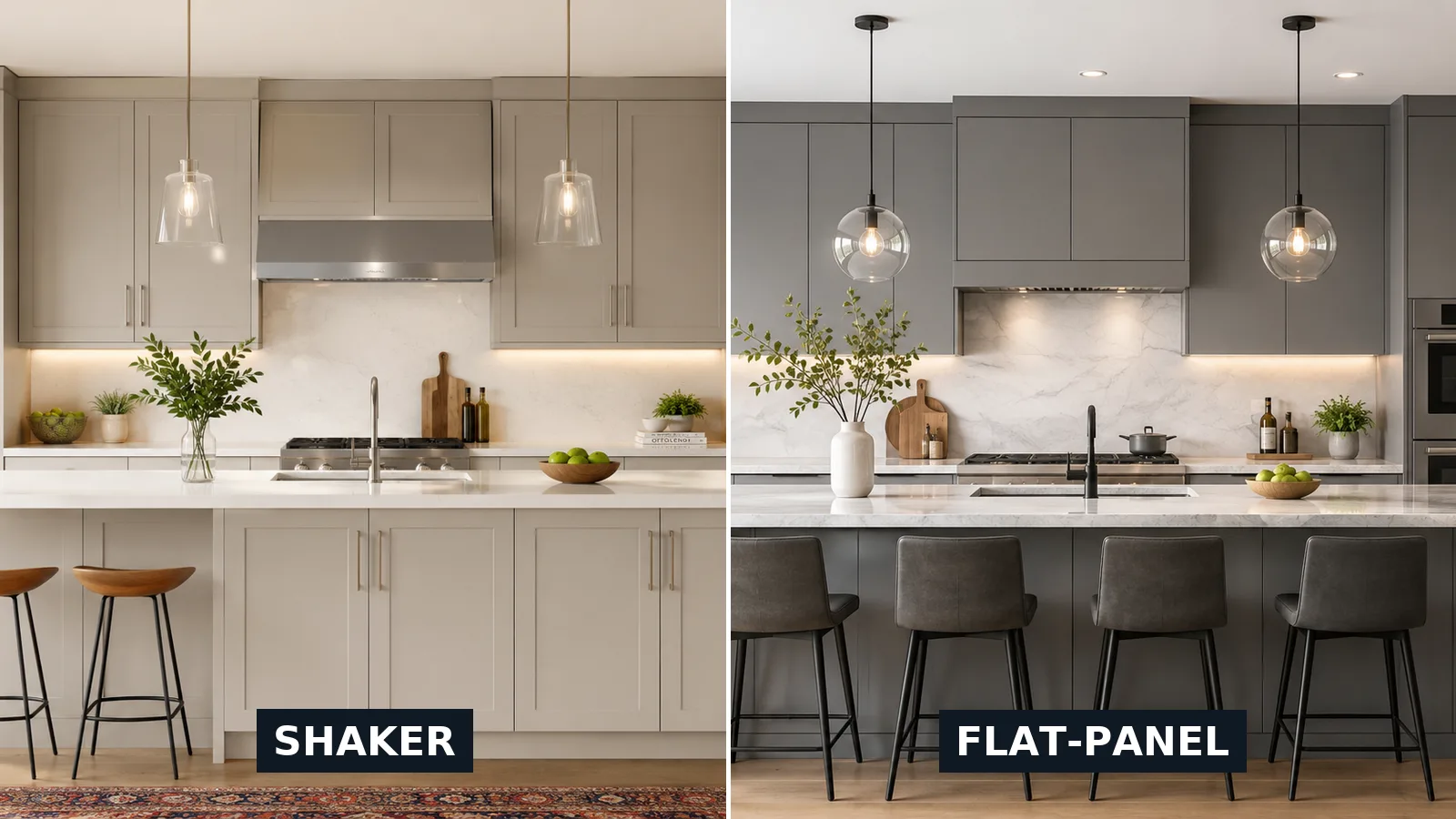
Shaker and flat-panel are the two cabinet door styles that dominate project specifications today, and they compete at the same price tier, on the same carcasses, in the same finishes. That makes the choice a pure design-and-operations decision—which is exactly why it deserves better than a list of pros and cons copied from a homeowner blog.
This guide compares the two styles on three factual levels: current market data, the production steps that actually create the price difference, and the maintenance realities that matter in apartments, hotels and villas. George Group manufactures both styles, so we have no preference to sell you—only data to show you.
Editorial disclosure: George Group publishes this guide and produces both door styles for export projects. Market figures below come from the cited industry studies, not from our sales records. Where a claim cannot be supported by a public source or a verifiable factory fact, we say so instead of estimating.
What Market Data Shows: Shaker Leads, Flat-Panel Is Gaining
The 2025 U.S. Houzz Kitchen Trends Study found shaker doors in 61% of renovated kitchens—far ahead of flat-panel at 22% and raised-panel at 12%. Two details inside that data matter for project buyers.
First, flat-panel was one of the few styles that gained share, rising 3 percentage points year over year. Second, the design profession expects that movement to continue: in the NKBA/KBIS 2026 Kitchen Trends Report, 69% of surveyed designers identified flat, slab door styles as a growing direction. (Both studies are linked in the sources at the end of this guide.)
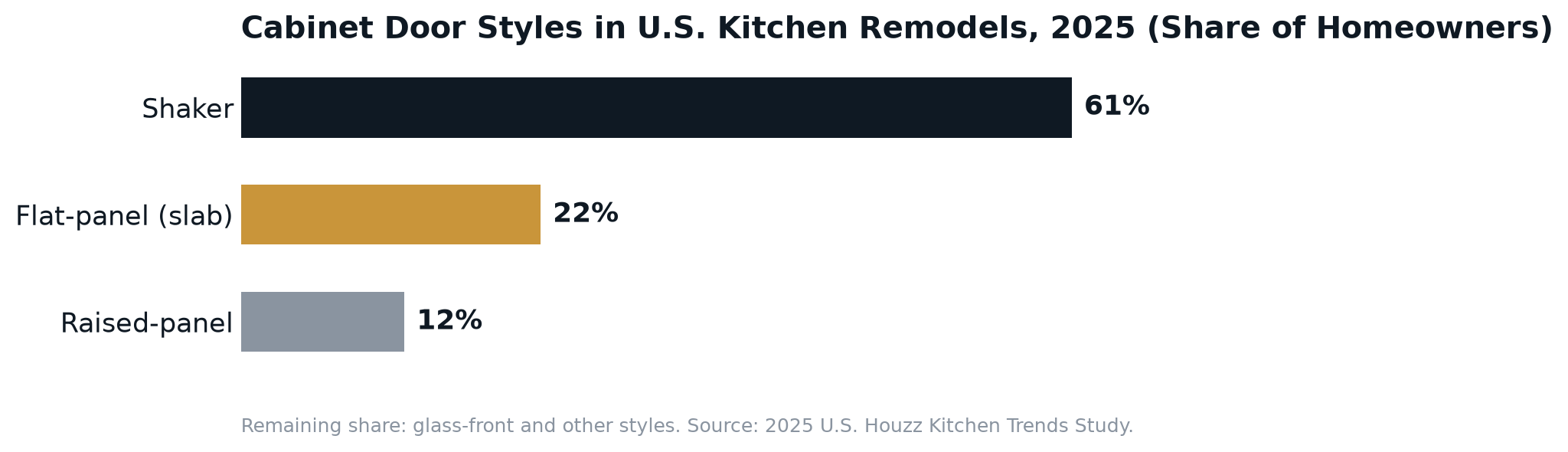
So, are shaker cabinets going out of style? The data does not support that claim. A 61% share is the broadest buyer acceptance any door style has—which is why shaker remains the safe specification where resale or leasing appeal matters. What the data does support is narrower: the growth is happening in flat-panel, driven by modern and minimalist project design. A defensible reading for a project buyer is not “which style wins,” but which audience your units are built for.
Same Kitchen, Different Door: Where the Price Difference Comes From
Buyers often ask for the price gap between the two styles as a fixed percentage. No honest factory can give one, because the gap is created by production steps—and those steps change with your material, finish and design choices. What we can show you is exactly where the difference comes from.
| Production stage | Shaker (5-piece door) | Flat-panel (slab door) |
|---|---|---|
| Components | Four frame pieces plus a center panel, machined and joined | One panel, cut to size |
| Machining | Profiling, grooving and joint cutting on every frame piece | Straight cuts and edge banding or lipping |
| Sanding and finishing | Profiles, corners and joints sanded and coated by hand and machine; more passes | Flat surfaces coat quickly and evenly; fewer passes |
| Assembly and QC | Joint alignment, panel float and gap checks per door | Flatness and edge-quality checks per door |
Whether that difference is large or small on your project depends on what the door is made of. A painted MDF shaker door and a laminate slab door sit close together; a solid-wood shaker door and a PET high-gloss slab door can invert the expected order entirely. Door style, substrate, finish and design complexity interact—this is why George Group quotes both styles on the same carcass and finish specification, so the door-style line is the only variable you are comparing. For the cost variables behind that comparison, see our kitchen cabinets from China price breakdown.
Lead Time and Maintenance: The Facts for Project Buyers
One question has a short answer: door style does not change your delivery date at George Group. Both styles run 30–45 days in production, because the carcass line, finishing line and approval gates are shared. Specify on merit, not on schedule anxiety.
Maintenance is where the two styles genuinely diverge, and where project-scale consequences hide.
The Shaker Joint Issue in Humid Climates
A shaker door’s frame and center panel are separate components, and wood-based materials expand and contract with humidity. Finish manufacturers and cabinetmakers openly document the result: hairline cracks in the paint film at frame-panel joints, especially when heating or cooling systems swing indoor humidity. The technical notes from General Finishes and Dean Cabinetry, linked in the sources below, both describe the mechanism.
For an export project this is a specification issue, not a reason to avoid shaker. It is managed with stable substrates, correct panel float, flexible finish systems and climate-appropriate construction—decisions your supplier should be able to explain for your destination market, whether that is a humid coastline or a heated northern winter. Ask any factory quoting shaker doors how they build for your climate; the answer tells you more than the price does.
The Flat-Panel Fingerprint and Edge Issue
A slab door has no joints to crack, but its flat, often handleless surface shows every fingerprint and smudge—most visibly on dark, matte and high-gloss finishes. In a private villa this is an annoyance; across 200 hotel kitchenettes cleaned daily, it is a labor and appearance issue. Slab doors also concentrate wear on their edges, where chipping is more visible than on a framed door. Finish selection (super-matte anti-fingerprint surfaces, durable edge banding) mitigates both, and belongs in the specification, not in an after-sales email.
Cleaning Labor in High-Turnover Properties
The shaker groove that collects dust in a home kitchen becomes a measurable cost in serviced apartments and hotels: every frame corner is extra wiping time, multiplied by units and cleaned daily. A flat-panel door wipes in one pass. If your project’s operating model includes professional cleaning at scale, put a number on that difference before you fall in love with a door profile—your housekeeping contractor can estimate it in minutes per unit.
Which One Should You Specify?
Apartment Developers
For volume units, flat-panel is usually the more defensible specification: visually uniform across hundreds of kitchens, fastest to clean between tenancies, and aligned with where design demand is growing (the NKBA data above). Where a development targets a premium buyer, shaker in a neutral painted finish remains the lowest-risk upgrade—it is the style 61% of renovating homeowners already choose. Our grey flat-panel kitchen cabinets show what the volume option looks like in a finished space.
Hotel and Hospitality Projects
Guest-room kitchenettes and serviced apartments live or die on daily cleaning, which favors flat-panel with an anti-fingerprint finish. Public-area and suite cabinetry, where perceived craftsmanship carries the room, can justify shaker. Many projects we supply mix both by zone—one finish color, two door styles—so the property reads as one design while each area gets the maintainability it needs.
Villa Owners
For a private residence, specify for the architecture and the next owner. Shaker’s framed depth suits transitional and classic interiors and carries the broadest resale acceptance in the Houzz data; flat-panel suits contemporary architecture where the cabinetry should disappear into the volume. Our shaker kitchen cabinets in cream or navy blue show how far the style stretches beyond the default white.
Distributors and Contractors
Stock what your market reorders. In North-American-influenced markets, shaker remains the volume line; in markets driven by new-build modern developments, flat-panel demand is the growing side. If you are still building a supplier shortlist, compare the manufacturers in our top kitchen cabinet manufacturers in China guide. Because George Group produces both on shared carcass and finish lines, you can run both styles in one order, one color standard and one container—without managing two factories to cover your catalog.
One Factory for Both Styles: What George Group Brings to Your Project
Because we manufacture both door styles, our only interest in your decision is that it survives contact with your project. Three things make that decision easier before you commit:
- Free 3D design. Send your floor plans and we render both shaker and flat-panel into your actual kitchen layouts. Door-style selection stops being imagination and becomes a side-by-side view of your own project—see how our design support works.
- Free door samples. We ship physical samples of both styles so you can check the frame joints, finish build and edge quality in hand—the exact failure points described above, verifiable before you order.
- Factory and supply-chain depth. A 30,000 m² showroom for side-by-side selection and 100,000 m² of manufacturing facilities in Foshan, with cabinets coordinated alongside wardrobes, doors, windows, tiles, sanitary ware, lighting and stone in one consolidated shipment—one color standard, one delivery window.
Production for either style runs 30–45 days, and export orders ship with the certifications your destination requires—CE, ISO and ETL documentation is available depending on the product and market. If you are still at the supplier-selection stage, our guide on how to evaluate a custom cabinet manufacturer applies the same verification standard to us as to anyone else.
Send your drawings, BOQ, quantities and destination country, and we will return two quotations on one specification sheet—same carcass, same finish, shaker versus flat-panel—so the door-style decision is the only variable left.
Frequently Asked Questions
Is flat-panel cheaper than shaker?
On identical materials and finishes, a slab door usually costs less to produce because it has fewer components and fewer finishing passes—but no fixed percentage exists. Substrate, finish system and design complexity can narrow, widen or even reverse the gap. The reliable method is a same-specification quote for both styles, where door construction is the only variable.
Are shaker cabinets going out of style?
The data says no. Shaker held 61% of U.S. kitchen remodels in the 2025 Houzz study—still the broadest buyer acceptance of any style. What is changing is the growth direction: flat-panel gained share year over year, and 69% of designers in the NKBA/KBIS 2026 report expect slab styles to keep growing. Shaker is the established volume; flat-panel is the current momentum.
Which is easier to clean in a rental or hotel property?
Flat-panel, clearly: one flat wipe per door, no frame grooves to detail. Shaker’s frame corners collect dust and grease and add wiping time per unit, which multiplies across a cleaned-daily property. If you specify shaker in a high-turnover property, budget the housekeeping time honestly.
Does door style affect production lead time?
Not at George Group. Both styles share the carcass line, finishing line and approval gates, and both run 30–45 days in production. Choose the style on design fit and operating cost; the schedule is identical either way.
Sources
- 2025 U.S. Houzz Kitchen Trends Study — cabinet door-style shares (shaker 61%, flat-panel 22%, raised-panel 12%) and year-over-year movement.
- NKBA/KBIS 2026 Kitchen Trends Report — 69% of surveyed designers identify flat, slab door styles as a growing direction.
- General Finishes technical FAQ — why painted cabinet joints crack when humidity swings.
- Dean Cabinetry: Paint Cracking on Cabinet Joints — the frame-and-panel movement mechanism.
- iCabinetry Direct cabinet-door care guide — cleaning behavior of recessed-panel versus slab doors.
Editorial Notes
- Production stages, the shared 30–45 day lead time, free 3D design, free samples, and showroom and factory figures describe George Group’s own operations and were provided by the publisher.
- This guide does not rank door styles or quote fixed price differences. Buyers should confirm material, finish and climate-related construction decisions against their own project specification and destination market.