

Whole-House Project Sourcing Guide
Last reviewed: August 2026
George Group coordinates whole-house customization for international project buyers: cabinetry, doors, windows, sanitary ware, furniture and interior materials, managed from floor plans and a bill of quantities through showroom selection, shop drawings, production, quality control and consolidated delivery. The service is built for villas, apartment developments, hotels and commercial projects—not for single-room retail orders.
This guide explains what a multi-category project actually requires, what buyers can accomplish inside George Group’s 30,000 m² showroom, how 100,000 m² of manufacturing facilities turn approved specifications into finished products, and what you should send before expecting a meaningful quotation. If you are building your supplier shortlist first, a Canton Fair sourcing trip can lead naturally into the Foshan showroom and factory visits described here.
Start with the files you have. Floor plans, a room schedule or a preliminary BOQ are enough to begin a project review. You do not need finished specifications before the first conversation—identifying what is missing is part of the work.
What China’s 2025–2026 Furniture Industry Data Means for Project Buyers
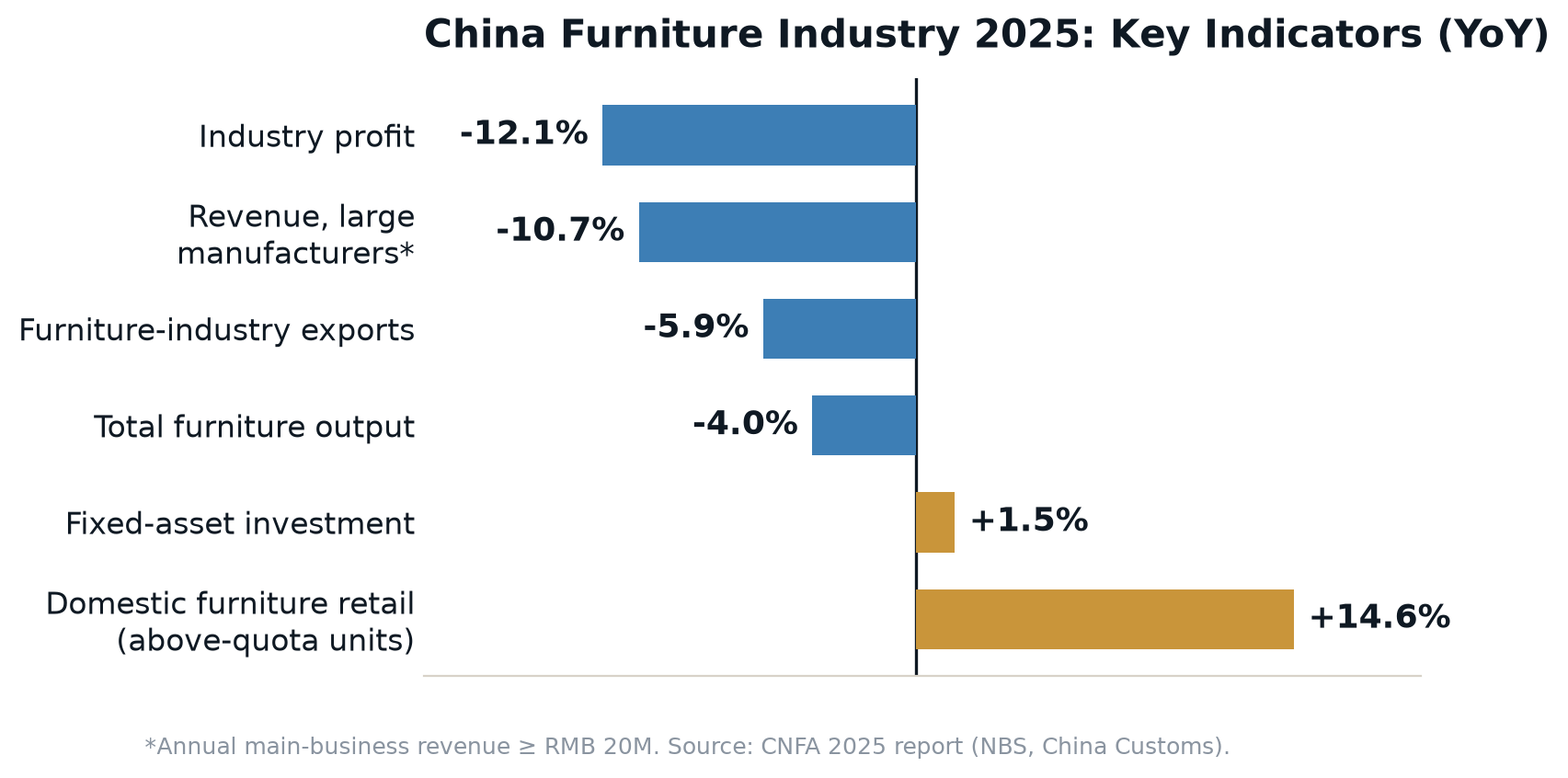
Buyers often ask whether China still offers a supply advantage, given the headlines about tariffs and a cooling domestic market. The China National Furniture Association’s full-year 2025 report—drawing on National Bureau of Statistics and customs data—gives a more useful picture than the headlines.
| Indicator (2025 full year) | Figure | Year over year | What it signals for buyers |
|---|---|---|---|
| Furniture-industry exports | USD 67.81 billion | −5.9% | Export-oriented factories are competing harder for overseas orders—negotiating room exists, but supplier financial stability matters more |
| Revenue of above-designated-size manufacturers | RMB 612.51 billion | −10.7% | The domestic market is contracting; capacity is available for export projects |
| Manufacturers above designated size | 7,467 enterprises | Stable above 7,400 | Supply depth is not the constraint—filtering and coordination are |
| Average operating profit margin | 5.4% (profit RMB 32.81 billion) | Profit −12.1% | Under-priced quotes are often recovered through substitution; itemized specifications protect the buyer |
| Domestic furniture retail (above-quota units) | RMB 209.19 billion | +14.6% | Subsidy-driven domestic demand competes for production slots; export orders need written milestones |
| Fixed-asset investment in furniture manufacturing | — | +1.5% | Factories kept investing through the downturn—capacity is being upgraded, not abandoned |
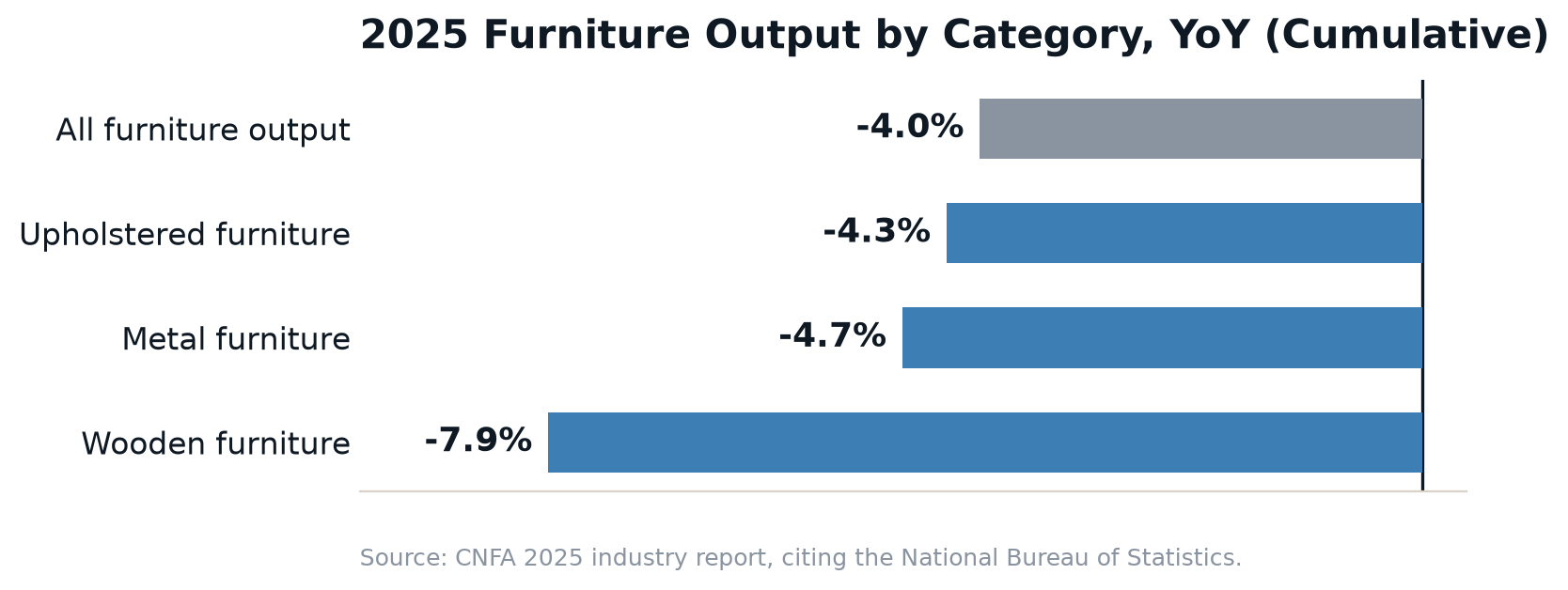
By category, the 2025 contraction was broadest in wooden furniture—the segment most exposed to the property-market adjustment—while metal and upholstered furniture declined more moderately. Production remains concentrated in the coastal clusters: Zhejiang ranks first by output, followed by Guangdong, Fujian, Jiangsu, Hebei, Shandong and Jiangxi—which is where export logistics, hardware supply chains and experienced labour already sit.
Read together, the figures describe a market with abundant, investing, competitively pressured supply. That is good news for project buyers on price and availability, and neutral news on outcomes: a 5.4% average margin industry does not absorb your specification errors for free. The buyers who benefit most from this market are the ones whose drawings, samples, approvals and inspection records are controlled tightly enough to hold factories to the quoted specification—which is precisely the work a coordination partner exists to do.
Early 2026: Exports Are Recovering, but the Destination Map Is Shifting
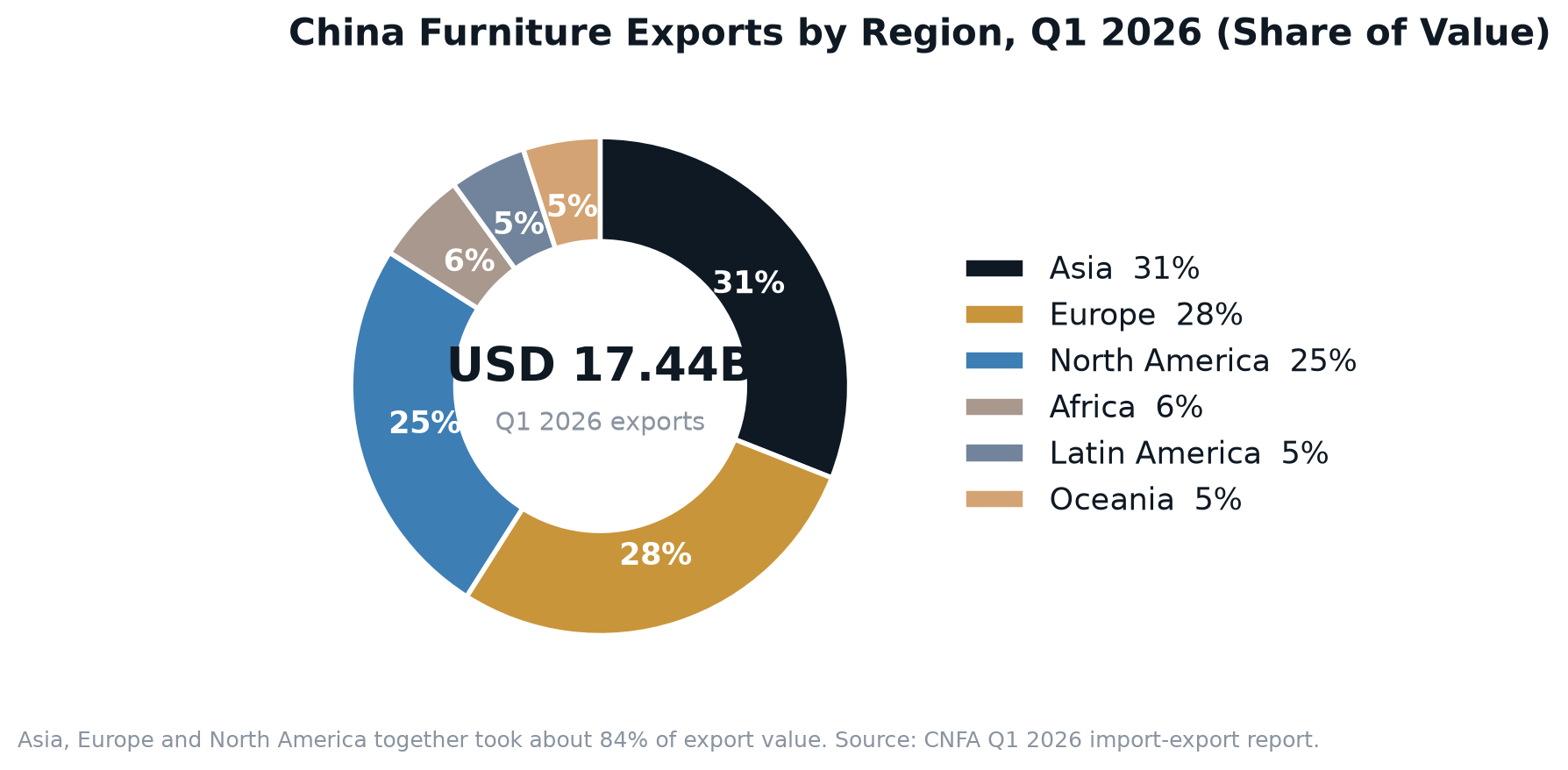
CNFA’s Q1 2026 import-export report adds an important update to the 2025 picture. Furniture exports reached USD 17.44 billion in the first quarter of 2026, up 3.4% year over year—a clear recovery from the 5.9% decline recorded for 2025 as a whole. Monthly figures remained volatile (January +5.4%, February +67.5%, March −32.7%), so the recovery should be read as stabilisation rather than a straight upward line.
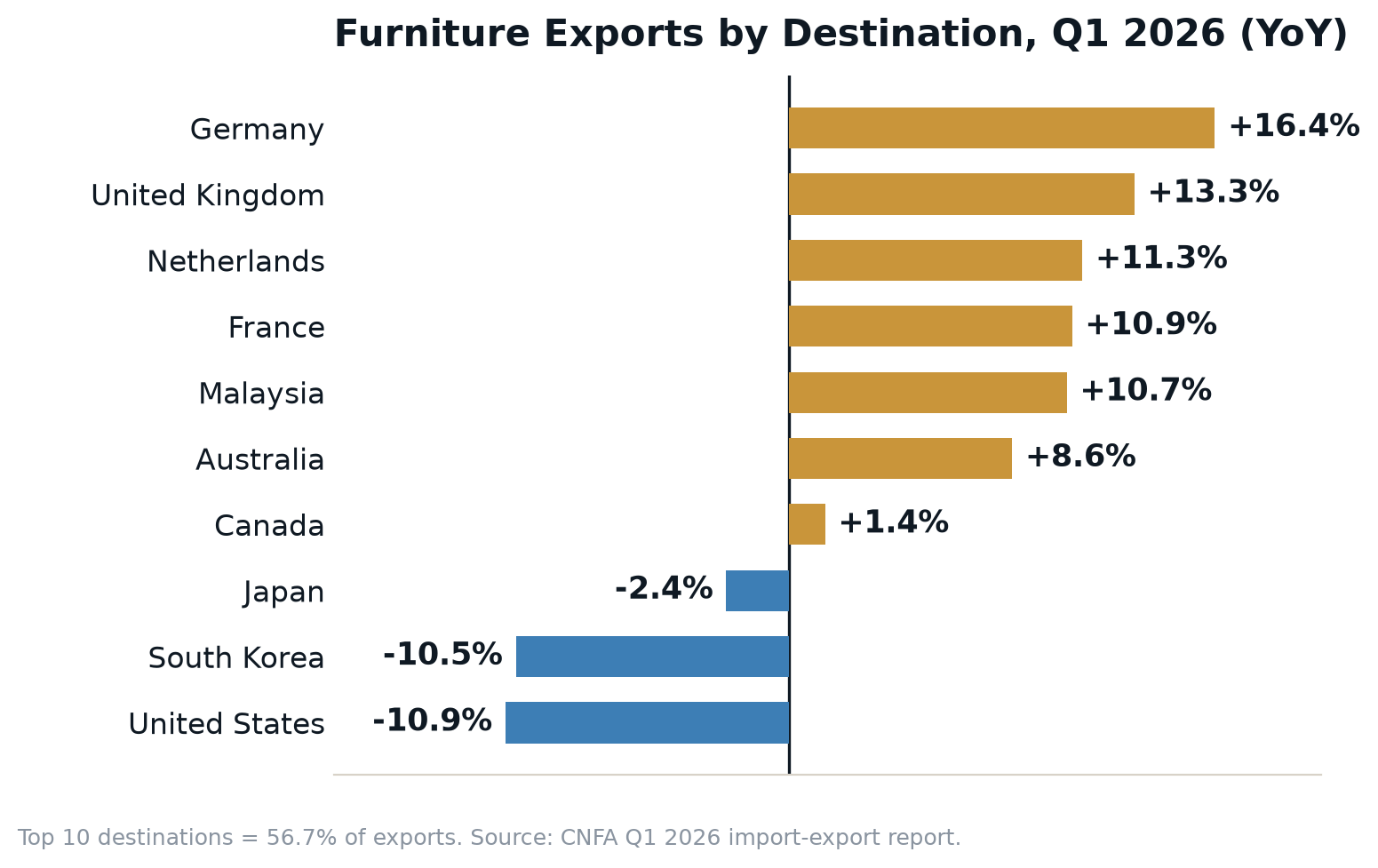
The more structural story is where the exports went. As the two charts above show, shipments to the United States—still the largest single market, at USD 3.91 billion and 22% of exports—fell 10.9%, while every major European market, Malaysia and Australia grew. Production geography is equally concentrated: Zhejiang and Guangdong together accounted for roughly 56% of export value in Q1 2026.
For project buyers outside the US, this shift works in your favour: factories are building current, documented experience with UK, EU, Australian and Southeast Asian requirements. For US-bound projects, it means the supplier you want is one whose export record to your market is specific and recent—not one quoting a generic “we export worldwide” line. Either way, quarterly volatility in both orders and freight argues for locking production slots and shipping windows into the contract rather than assuming they will be available when the design is finally approved.
The Real Challenge Is Coordinating Multiple Product Categories
A whole-house project rarely fails because a product category is unavailable. China offers more suppliers, in more price bands, than any other furniture and building-material market. Projects fail at the interfaces between suppliers: the cabinet factory, the door factory, the window factory and the tile supplier each deliver a correct product against their own drawing—and the pieces do not fit together on site.
Where Multi-Supplier Projects Usually Break Down
- Drawing revisions are not synchronized, so one factory produces to a superseded plan.
- Cabinet, door and wall-panel finishes are approved from separate samples and do not match under site lighting.
- Windows, doors and cabinets are measured against different site information.
- Production schedules do not align, so part of the order waits in storage while the rest is delayed.
- Packaging labels do not follow the room or floor sequence the installation crew expects.
- Missing items are discovered only after the container arrives, when replacement takes weeks.
Each problem is small in isolation. Together they decide whether a project finishes on schedule or spends its contingency budget on air freight and rework.
What One Project Team Changes
George Group replaces supplier-by-supplier management with a single coordination layer built around the project. In practice that means one room-by-room product schedule, one revision-control process, one material and finish approval record, one milestone and inspection overview, and one final packing and loading reconciliation before the container leaves.
The buyer still approves every important decision—drawings, samples, finishes, quantities and the final packing list. The difference is that those approvals are connected, so a change to a wardrobe layout cannot silently contradict the door schedule.
George Group’s Project Infrastructure
Coordination claims are only credible with physical capacity behind them. George Group operates a 30,000 m² multi-category showroom and 100,000 m² of manufacturing facilities, and the two serve different stages of the same project.
| Facility | Scale | Role in your project |
|---|---|---|
| Multi-category showroom | 30,000 m² | Cross-category selection, full-scale product comparison, physical sample and finish approval, drawing review with the project team |
| Manufacturing facilities | 100,000 m² | Custom production against approved shop drawings, materials and samples, with inspection and packing for consolidated export |
30,000 m² Multi-Category Showroom
The showroom exists to shorten decisions. Instead of collecting catalogues from six suppliers and comparing finishes on a screen, a buyer can walk between full-scale kitchens, wardrobes, door and window displays, sanitary ware, furniture and material libraries in one visit, and leave with a selection schedule tied to the project’s rooms. The showroom’s value is not its size; it is that cross-category decisions—whether the wardrobe finish works next to the door finish—happen with physical samples in the same light.
100,000 m² Manufacturing Facilities
The manufacturing facilities take over after approvals. Production begins only when shop drawings, material and finish schedules, hardware schedules and physical samples are confirmed, because custom production against an unapproved drawing simply manufactures the mistake faster. George Group does not claim that one production line makes every category; whole-house projects depend on specialized production, coordinated under one project-management record.


What Buyers Can Complete During a Showroom Visit
A common buyer question is fair: a 30,000 m² showroom sounds impressive, but what do you actually accomplish there? A planned visit produces five concrete outputs.
Build a Room-by-Room Selection Schedule
Work through the project by villa zone, apartment type, hotel room or public area, and record products against spaces—not against supplier categories. A selection schedule organized by room becomes the skeleton for the quotation, the packing list and the installation sequence.
Compare Full-Scale Products and Physical Samples
Evaluate cabinetry, doors, windows, sanitary ware and furniture at real size: door weight and hinge action, drawer hardware, profile depth, glaze texture, fabric hand. Catalogue images compress these differences; physical comparison exposes them before they become change orders.
Coordinate Finishes Across Categories
Select cabinet, wall-panel, door, stone and furniture finishes side by side and lock them into a material and finish schedule with sample references. Screen images cannot substitute for this step—colour temperature and gloss level behave differently in print, on monitors and on site.
Review Drawings with the Project Team
Sit down with the team and the architectural set: find missing dimensions, confirm window and door openings, appliance positions, plumbing points and product interfaces, and list the decisions still required before quotation. Buyers typically leave this session with a shorter open-questions list than they arrived with.
Arrange Relevant Factory Visits
Where the project justifies it, visits extend to the production facilities relevant to your categories. The purpose is verification, not tourism: confirm the production equipment, in-process inspection points and packing area behind the products you are about to approve.
From Floor Plans to an Itemized Project Quotation
Cost is usually the first question and the last one that can be answered honestly. A whole-house price without specifications is a guess dressed as a number, so George Group builds quotations from documents—not from square-metre averages.
| What the buyer sends | What George Group reviews | What the quotation shows |
|---|---|---|
| Architectural drawings / floor plans | Missing dimensions and technical information | Product code and room code |
| Preliminary BOQ or room list | Required product categories and quantities | Dimensions, quantity, unit and calculation basis |
| Door and window schedules | Cross-category interfaces and openings | Material, finish, hardware and accessories |
| Style references and target specification level | Sample and mock-up requirements | Packing method and commercial terms |
| Destination country and target delivery date | Shipment and consolidation assumptions | Options, exclusions and validity |
An itemized quotation is comparable: you can line it up against another supplier’s offer row by row and see where specifications diverge. A single lump sum hides the divergence until production, when the negotiation position has reversed. If your project documentation is still incomplete, send what exists—the review stage is designed to identify gaps, not to penalize them.
Coordinating Cabinets, Doors, Windows and Interior Products
The coordination work differs by category, because each product touches the building differently. The matrix below summarizes what has to be aligned for each—and links to the relevant George Group product range.
| Category | Project interfaces to coordinate |
|---|---|
| Kitchen cabinets and wardrobes | Layouts, appliance positions, wall conditions, finish matching, hardware schedules |
| Interior and entrance doors | Opening schedule, wall thickness, swing direction, locks, finish coordination |
| Windows | Profile series, glass build-up, opening method, drainage, destination performance requirements |
| Sanitary ware | Plumbing positions, dimensions, accessories, room codes |
| Furniture | Room schedules, upholstery, dimensions, finish matching with joinery |
| Stone, tiles and lighting | Cutting lists, layout drawings, batch consistency, voltage and specification documents |
Note what this table does not do: it does not explain what a kitchen cabinet is. Buyers at this stage know the products; what they need is confidence that the products will arrive dimensionally consistent, finish-matched and documented for the same building.
Production, Quality Control and Approval Gates
A 100,000 m² facility figure means little without a control process inside it. George Group structures production around approval gates, each with documents the buyer receives or signs.
Before Production
- Shop drawings with revision numbers
- Material and finish schedule, approved against physical samples
- Hardware schedule
- Mock-up or sample approval record where required
- Confirmed quantities against the room-by-room BOQ
During Production
- Production milestones against the project schedule
- First-article comparison for repeatable items where applicable
- Dimension and finish checkpoints at agreed stages
- Change and issue records, resolved before packing
Before Shipment
- Specification and quantity verification against the packing list
- Visible finish, function and operation checks
- Label verification: product, room code and carton number
- Corrective-action status closed or documented
Compliance sits inside the specification, not beside it. US-bound composite wood products may fall under EPA TSCA Title VI; construction products for the European Union may require review under the Construction Products Regulation. The applicable standard should be confirmed for the destination market before the specification is approved, not after the goods arrive. Buyers evaluating individual factories within a package can apply the same method in our guide to choosing a custom cabinet manufacturer.
Consolidation, Packing and International Delivery
For buyers sourcing several categories, the moment of truth is consolidation: whether products from different production lines arrive together, complete, and identifiable by the installation crew.
Room-by-Room Identification
Every carton carries the project code, building, floor and room, the product and item number, the carton number, and the installation sequence where the project requires it. A container that arrives as a searchable inventory is a different asset from a container that arrives as a puzzle.
Consolidation Control
Consolidation runs on records: a supplier receiving record when goods enter the consolidation warehouse, a missing-item report while there is still time to act on it, quantity reconciliation against the order, a consolidated packing list, and a container loading record. The buyer sees the same documents, so the container’s contents are never a matter of trust.
What Consolidation Does Not Mean
Not every product belongs in the same container. Production timing, weight and dimensions, fragility, packing compatibility and customs documentation all shape the loading plan. Stone and lighting travel under different constraints; a credible consolidation plan says so, rather than promising that everything ships together because it was ordered together.
George Group Project Case Study
Case content reserved. This section is held for a documented George Group whole-house project. It will be published only when the project record—client context, scope, approvals, production, inspection and delivery evidence—can be presented without embellishment. No illustrative case is substituted in the meantime.
When published, the case will cover the client and project challenge, country and project type, floor area or number of units, categories supplied, George Group’s scope, the drawing and specification challenges, the sample and approval process, production and QC records, containers delivered and the final result—supported by showroom, production, packing and completed-site photography.
Questions Project Buyers Ask Before Sending Drawings
Can George Group prepare a quotation from architectural drawings?
Yes. A review can start from architectural plans, a preliminary BOQ, room schedules or reference images. The team first identifies missing dimensions, specifications and commercial decisions, then confirms the open items with you before pricing.
Can buyers visit the showroom and manufacturing facilities?
Yes. Project discussions can include showroom selection sessions and visits to the production facilities relevant to your categories, arranged around the samples, approvals and decisions your project requires.
Can finishes be coordinated across different product categories?
Yes—through physical samples, material codes and an approved finish schedule, confirmed across categories before production release. Finish coordination is done with real samples in one place, not by exchanging photographs between factories.
Can products from different production lines be consolidated?
Yes, when production timing, packaging, weight, volume, fragility and customs documentation are compatible. Consolidation is planned with receiving records, missing-item reports and a reconciled packing list—not assumed.
Can buyers arrange third-party inspection?
Yes. The inspection right, timing, scope and acceptance criteria should be agreed in the purchase documents before production begins, so inspection results are actionable rather than advisory.
What information is required for a project proposal?
Floor plans or architectural drawings, the project type, destination country, target delivery date, required product categories, style references and any existing BOQ or technical schedules. Incomplete files are acceptable—the review identifies what is missing.
What documents are provided before production and shipment?
Before production: room-by-room BOQ, approved shop drawings, material and finish schedules, hardware schedules and sample approval records. Before shipment: inspection records, product and carton identification, the consolidated packing list, quantity reconciliation and the container loading record.
How are replacement parts or missing items handled?
Missing-item risk is controlled at consolidation through receiving records and quantity reconciliation, before the container closes. For hardware and replaceable components, the order documentation should identify spare kits, replacement procedures and claim contacts—agree these terms before balance payment.
Planning a Villa, Apartment, Hotel or Commercial Project?
Send George Group your floor plans, target market, product scope and expected delivery schedule. The project team will review the available information and define the next sourcing, design and quotation stage.
Sources and Editorial Notes
- 2025 full-year industry figures are from the China National Furniture Association’s 2025 China furniture-industry economic report, which cites the National Bureau of Statistics and the General Administration of Customs. “Above-designated-size” manufacturers are enterprises with annual main-business revenue of RMB 20 million or more.
- Q1 2026 import-export figures are from CNFA’s 2026 first-quarter China furniture-industry import-export report (republished full text; CNFA original page, body behind a member login). Quarterly data is presented as Q1 only and is not extrapolated to full-year 2026.
- George Group facility figures (30,000 m² showroom; 100,000 m² manufacturing facilities) are company-provided. Supporting facility photography will accompany this article at publication.
- Regulatory references: US EPA TSCA Title VI and the EU Construction Products Regulation. Applicable requirements depend on the product and destination market and should be confirmed with local professionals.
- This article describes George Group’s project-coordination process. It does not constitute a price commitment, lead-time guarantee or third-party endorsement; commercial terms are defined in the project quotation and contract.